Pickleball Court Lighting for Evening Play: A Practical Visibility Checklist
A practical checklist for comfortable evening pickleball: test both baselines, spot glare and shadows, and improve court lighting without simply adding more brightness.
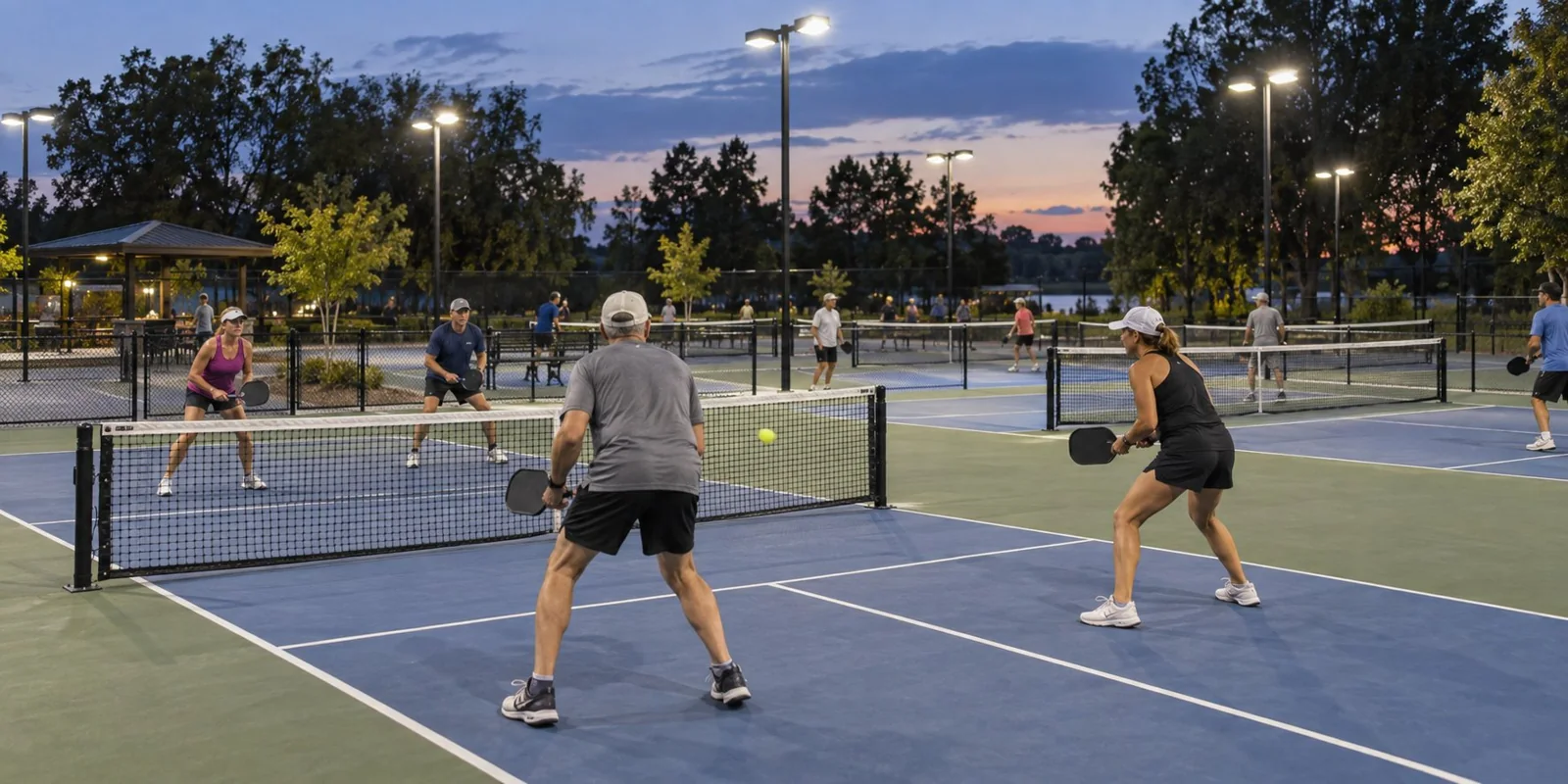
Evening pickleball can be a great way to keep playing after work, but a court that looks bright from the fence may still produce distracting glare, dark corners, or confusing shadows. Good lighting is not simply a matter of adding more lamps. Players need to see the ball early, judge its height, and track it against a background without losing sight of nearby players.
What makes pickleball court lighting comfortable?
Useful court lighting spreads light across the playing area instead of creating one intensely bright patch. The net line, non-volley zone, baseline, and sidelines should be easy to distinguish from the surrounding surface. When illumination changes sharply from one end of the court to the other, the ball can seem to disappear during a change of direction.
Uniformity matters because pickleball is played at close range and the ball moves quickly through different parts of the court. A player looking from a darker baseline toward a bright fixture may see a momentary flare. The same problem appears when a light sits directly in the normal sightline for a high return or lob. Fixtures should therefore be aimed to illuminate the court, not the players’ eyes.
The background matters too. Trees, fencing, and parked cars can create visual clutter behind the ball. A tidy court edge and a consistent, non-reflective backdrop make the ball easier to read than extra brightness alone. If a facility is planning improvements, a short player test at both baselines is more useful than judging the installation from the parking lot.
A player’s evening visibility checklist
Before joining a night session, stand at each baseline and watch a few warm-up balls. Check whether you can follow a deep serve, a soft shot near the kitchen, and a high ball without turning away from the court. Ask a partner to hit from both sides because glare often affects one direction more than the other.
Look for these warning signs:
- A lamp is visible as a bright disc above the net or near the expected ball path.
- The ball vanishes briefly when it crosses from one lighting zone into another.
- Shadows from the fence or net make the landing area difficult to judge.
- The surface looks shiny enough to reflect light into your eyes.
- One baseline feels comfortable while the opposite end causes squinting.
If any of these appear, slow the warm-up and tell the session organizer before competitive play begins. Players should not try to solve a lighting problem by wearing a dark visor or staring directly toward a fixture. A hat brim can help with stray light, but it cannot correct an uneven installation.
How facilities can improve a community court
Start with observation at playing height. Walk the court with several players, including someone who normally receives from each baseline. Record the troublesome viewing directions, the time they occur, and whether the issue is glare, shadow, reflection, or insufficient light. This simple log gives an installer a clearer brief than the request for “brighter lights.”
Fixtures should be shielded or repositioned when they shine into normal lines of sight. The answer may involve aiming, spacing, mounting height, or adding a second lower-intensity source rather than increasing output from an existing lamp. Any change should be checked after dark from the court itself, because an adjustment that looks sensible from outside can still create glare during a lob.
Maintenance is part of visibility. Clean lenses, replace failed lamps promptly, trim branches that intrude into the background, and keep fencing tight enough that it does not flap across the sightline. If lights are timed, leave enough warm-up and cool-down margin for players to finish safely rather than switching off immediately after a booking ends.
Safer habits when the lights are imperfect
Choose controlled targets instead of ambitious deep lobs when the ball is hard to see. Communicate early on overheads and avoid standing where a partner’s movement is hidden by a dark patch. Give new players extra space while they learn the court’s viewing angles, and pause play if a failed lamp creates a genuine hazard.
A comfortable evening court lets players concentrate on footwork, spacing, and shot choice rather than fighting the environment. The best test is practical: several players should be able to track ordinary balls from both ends, with no fixture dominating the view and no abrupt dark area near the lines.