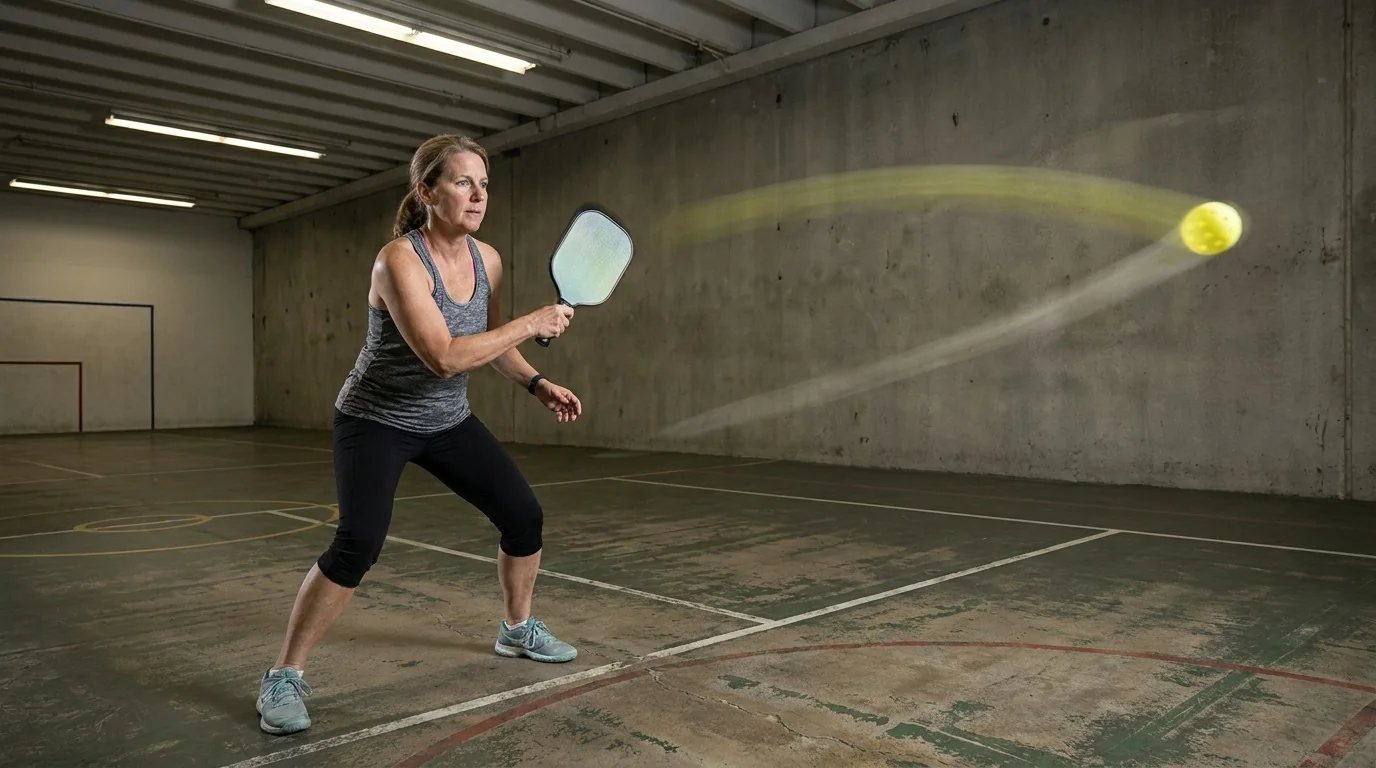
Pickleball Movement Timing: Land Balanced Before You Move
Build better pickleball movement by timing a small split step with your opponent’s contact, then reading the ball before the first recovery step.

The split step is not a jump for its own sake. It is a small timing move that helps you land balanced as your opponent hits, so you can push in the direction the ball actually takes. In this pickleball split-step drill, the goal is to connect the landing, the read, and the first recovery step instead of moving early and getting stuck.
Find the right moment
Start near the non-volley zone line with your paddle in front and your feet about shoulder width apart. As your opponent begins the forward part of the swing, make a small hop or unweighting step. Land softly with both feet available to push. Your timing target is simple: be settled as the ball leaves the opponent’s paddle, not while the ball is already halfway to you.
Keep the movement small. If you jump high, your feet spend too long off the ground and the ball reaches you before you are ready. Bend the knees slightly on landing, keep your chest quiet, and avoid crossing your feet. The split step should leave you able to move left, right, forward, or back without first correcting your balance.
Read first, then move
After the landing, watch the ball and the hitter’s contact. If the ball is coming toward your backhand, push from the outside foot and use short adjustment steps. If it is wide to the forehand, turn your hips and move without leaning your upper body ahead of your feet. When the ball stays in front of you, keep the paddle up and prepare for a compact shot rather than reaching from a static stance.
Do not commit to a direction before you have information. Early movement can open the middle or leave you reaching when the ball changes angle. The split step buys you a brief moment to see the ball, but it only helps if your landing remains neutral.
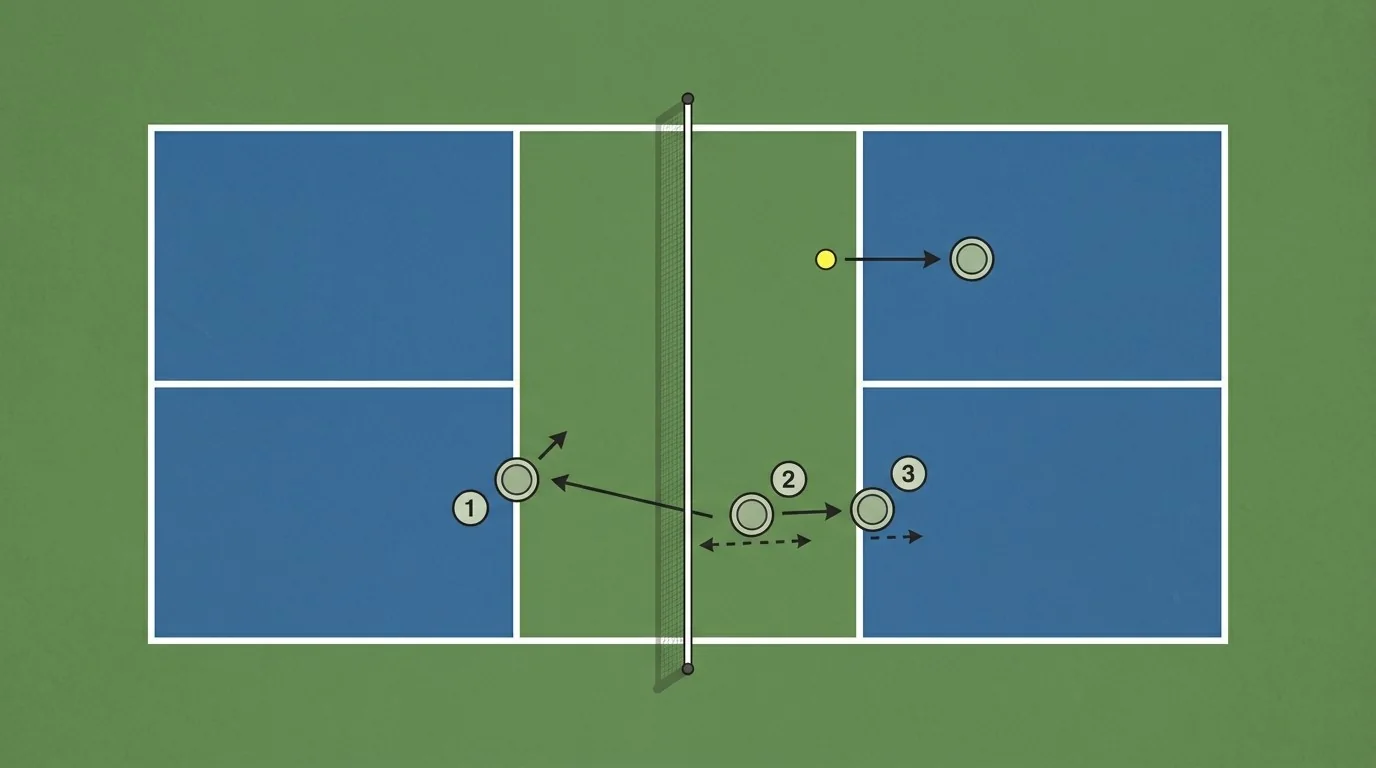
Three progressions for practice
1. Shadow timing. Stand at the kitchen line while a partner points or makes a quiet mock swing. Land the split step when the swing reaches contact, then freeze for a moment with the paddle ready. Check that both feet can push in either direction. Keep the rehearsal slow enough to notice whether you are jumping too high.
2. Cooperative feeds. Have your partner feed softly to the left, middle, or right after the split step. Your job is to land balanced, take the smallest useful adjustment steps, and play a controlled ball. Return to ready position after every repetition. Change the feed only when you can keep the first step calm.
3. Read and recover. Begin with a short dink exchange. The feeder varies the direction while keeping the pace cooperative. Split on the opponent’s contact, move to the ball, play a safe dink or reset, and recover your paddle to the front of your body. If you are pulled too far, stop chasing the planned shot and regain balance first.
Common mistakes
A split step that happens too early leaves you waiting with heavy legs. If that happens, delay the landing until the opponent is closer to contact. A split step that is too large turns into a jump and slows the next push. Reduce the height and focus on a quiet landing.
Another mistake is watching your own paddle after contact. Keep your eyes on the opponent and the ball so the next cue arrives early. Finally, do not finish the shot with your feet frozen. The useful sequence is land, read, move, strike, and recover. Practise that sequence at a manageable pace, then add more direction and speed only when your base stays stable.