Pickleball Court Positioning: Move With Purpose
A practical guide to pickleball court positioning: understand the three zones, advance in stages, time the split-step, and recover with your partner.
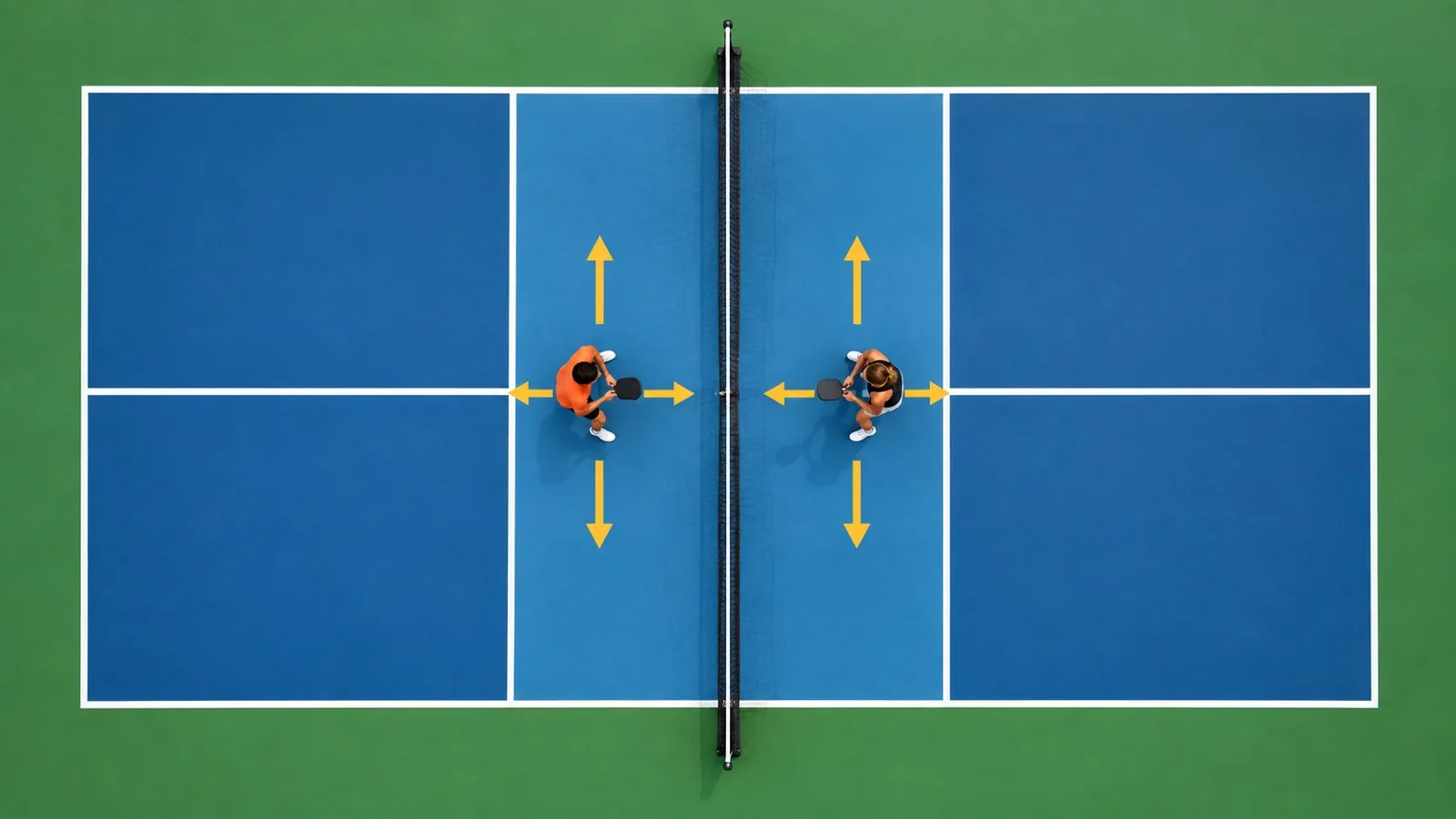
pickleball court positioning matters more than many players expect. A clean stroke from a poor location still leaves you defending, while a controlled shot from a balanced position gives you time and options. The practical goal is simple: move toward the kitchen under control, stop when the opponent makes contact, and keep your partner connected to you.
The three court zones and what they demand
The baseline is a defensive starting point. From there, the net is farther away, many balls rise on the way over, and the opponent has more time to react. You will play there after serving or while recovering, but it should rarely be your permanent doubles station.
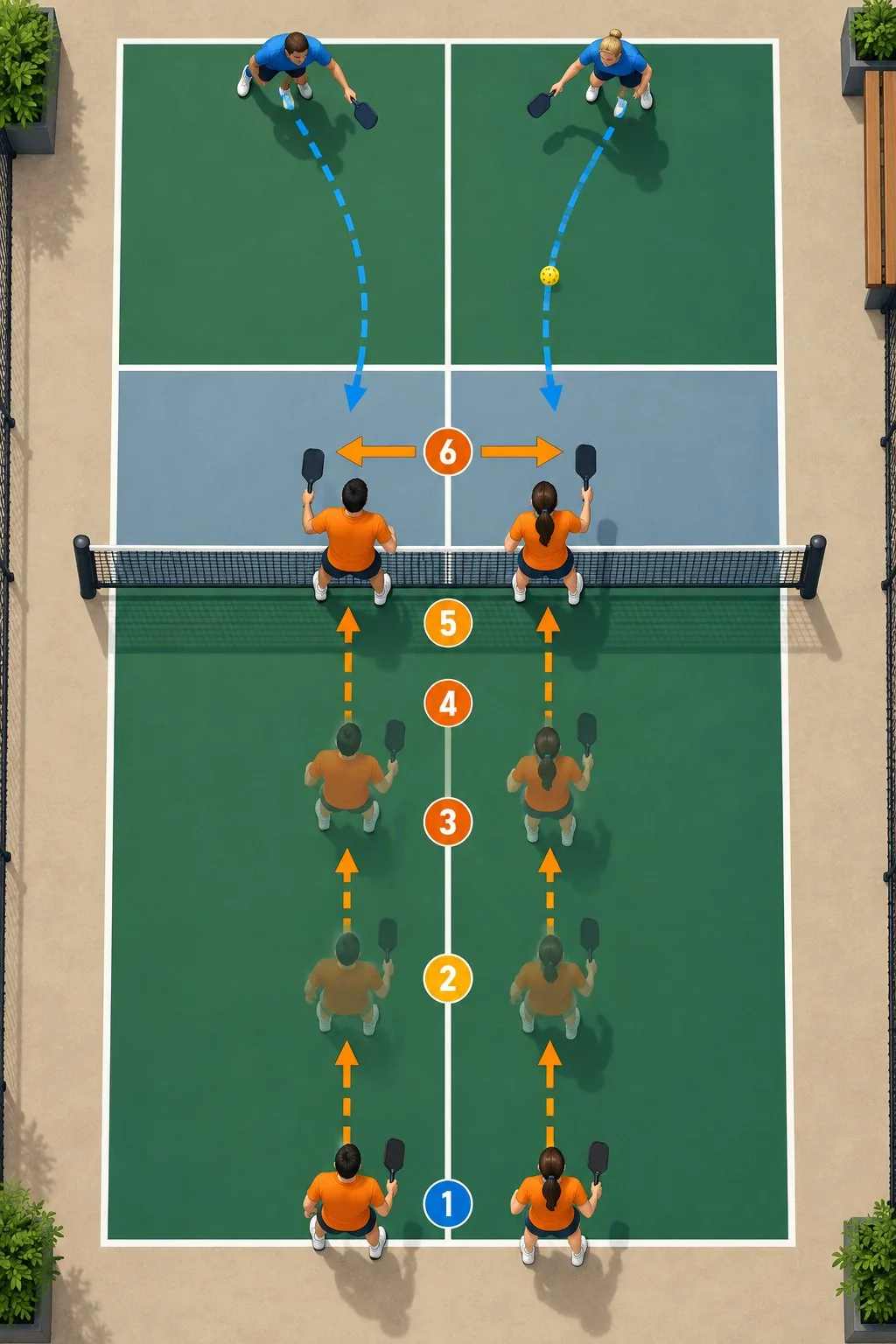
Between the baseline and the kitchen is the transition zone, often called no-man's-land. It is uncomfortable because balls arrive at your feet and the distance makes both volleys and bounce shots awkward. Do not treat it as a place to stand. Treat it as ground to cross in short, readable stages.
The kitchen line is the strongest general position in doubles. You take the ball earlier, reduce the opponent's reaction time, and can control angles. Stand just behind the line with soft knees, a paddle in front of your chest, and enough space to adjust without touching the non-volley zone.
How to move from the baseline without getting stuck
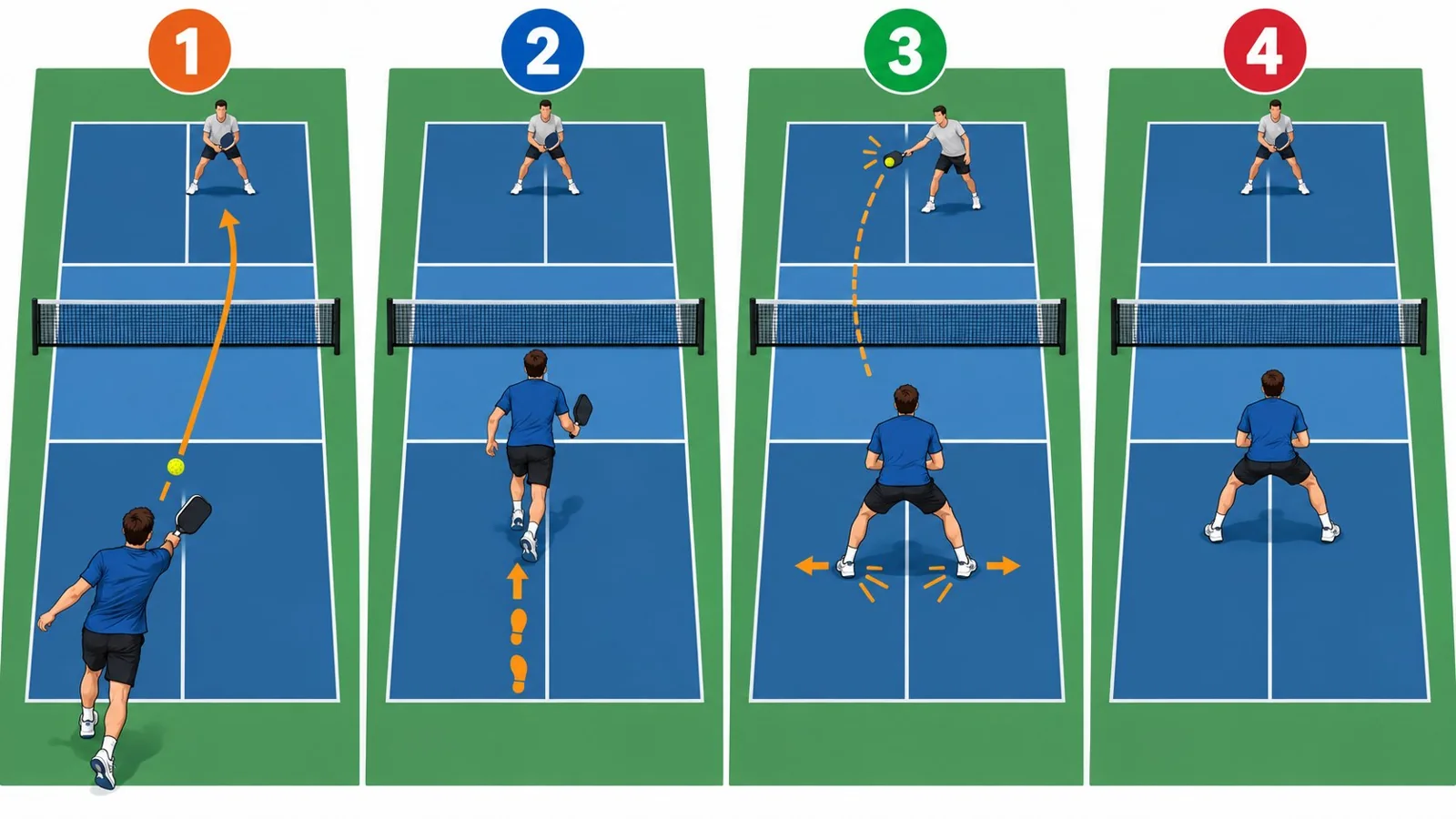
After a return that clears the net, move forward rather than admiring the shot from the baseline. A useful sequence is return, advance two or three steps, split-step as the opponent contacts the ball, then read the result before advancing again. The pause is not wasted time; it keeps your feet ready for a ball to either side.
Do not sprint continuously to the kitchen. If the opponent can attack, stop and prepare for a reset. If their contact is low and defensive, close the distance. In the transition zone, smaller steps are safer than a long lunge because they let you adjust the strike zone and keep the paddle in front.
Doubles spacing, singles recovery, and shot choice
Partners should move forward and backward together. One player at the baseline while the other reaches the kitchen creates a gap that opponents can target. Keep a roughly side-by-side relationship, communicate on middle balls with short calls such as “mine” or “yours,” and recover toward your shared shape after being pulled wide.
Singles requires more court coverage. Stay somewhat farther behind the kitchen line, recover toward the center after each shot, and shade your position according to the opponent's location. The aim is not to stand on one perfect mark; it is to arrive early enough to play the next ball in balance.
Position and shot selection work together. From the baseline, choose controlled depth rather than forcing a low-percentage attack. In transition, soften a fast ball and advance when the reply is safe. At the kitchen, hold your ground, move laterally with short steps, and wait for a ball high enough to attack.
Common mistakes and a practical checklist
The usual errors are staying behind the baseline after a return, rushing through transition without a split-step, stopping in the middle of the court, separating from a partner, and continuing toward a ball while already off balance. Fix them one at a time.
For the next session, use this compact checklist:
- move forward after every sound return;
- advance in bursts, then stop and read;
- land the split-step as the opponent contacts the ball;
- keep the paddle in front and your weight centered;
- keep doubles partners connected;
- recover toward the best position after each shot.
Practise the movement without a ball first: start at the baseline, take three steps, freeze in a ready stance, and repeat until the stop feels natural. Then add a partner feed and make the split-step respond to contact, not to the start of the swing. Better positioning will not replace technique, but it gives every technique a fair chance to work.