Pickleball Overhead Defense: Stay in the Rally
A practical guide to reading overheads, absorbing pace, choosing a counter-lob, and recovering as a team.
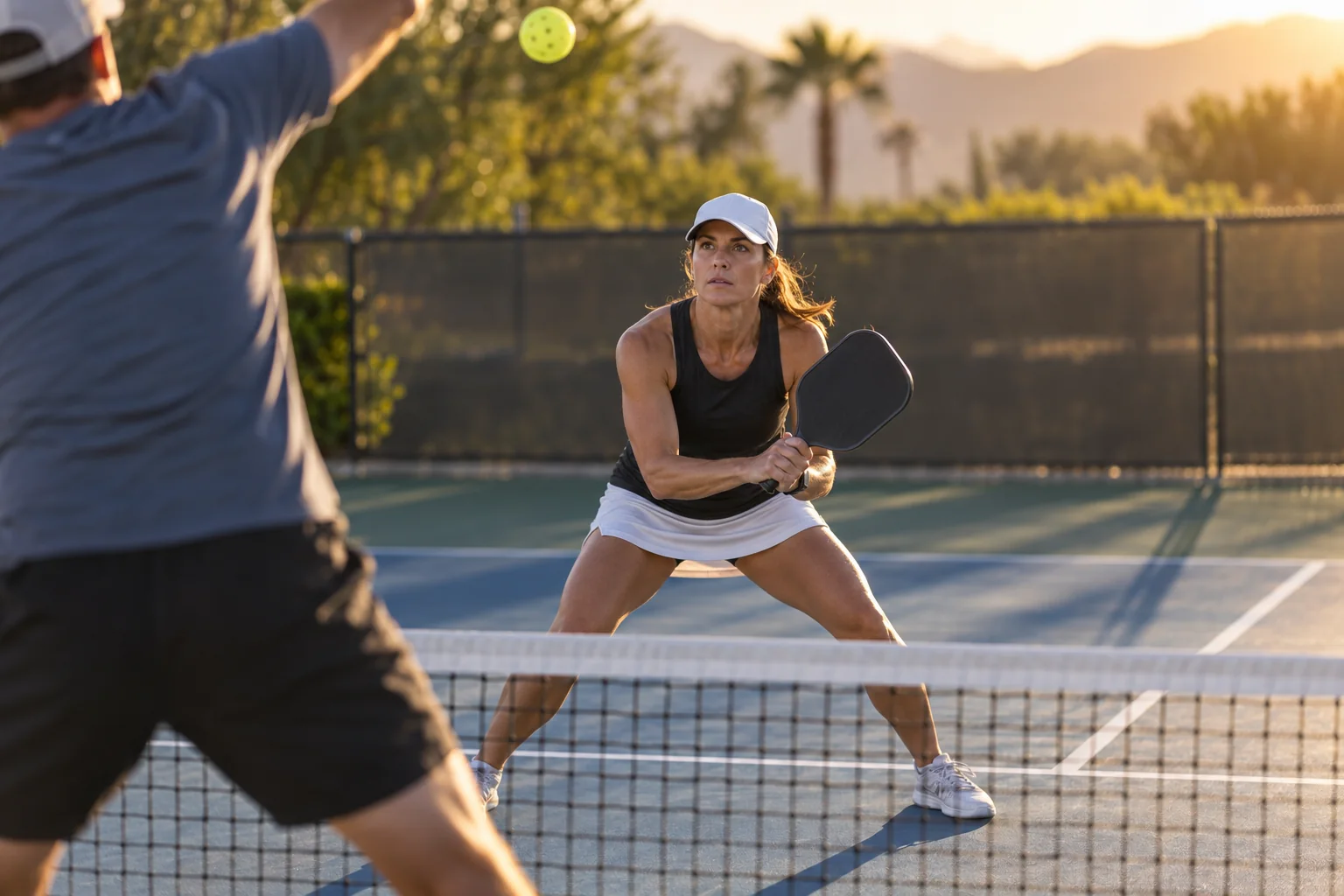
Pickleball Overhead Defense starts before contact: read the attacker, give yourself room, stay low, and return a ball your team can play. A hard overhead is not automatically a winner. Good defense turns one dangerous shot into another decision for the opponent.
How to read a pickleball overhead
Watch the hitter’s shoulders and feet, not only the ball. A player moving backward or opening the shoulders may need more time to control the overhead; a balanced player moving forward can strike harder. Take a small split step as the opponent contacts the ball, then settle with knees bent and the paddle in front.
Create space before the smash arrives. If you stand inches from the kitchen line while your opponent is set to attack, the ball may reach your feet before you can react. Move back enough to see the flight and keep the ball in front of your body. Do not backpedal blindly; turn, run, and then brake.
How to block an overhead softly
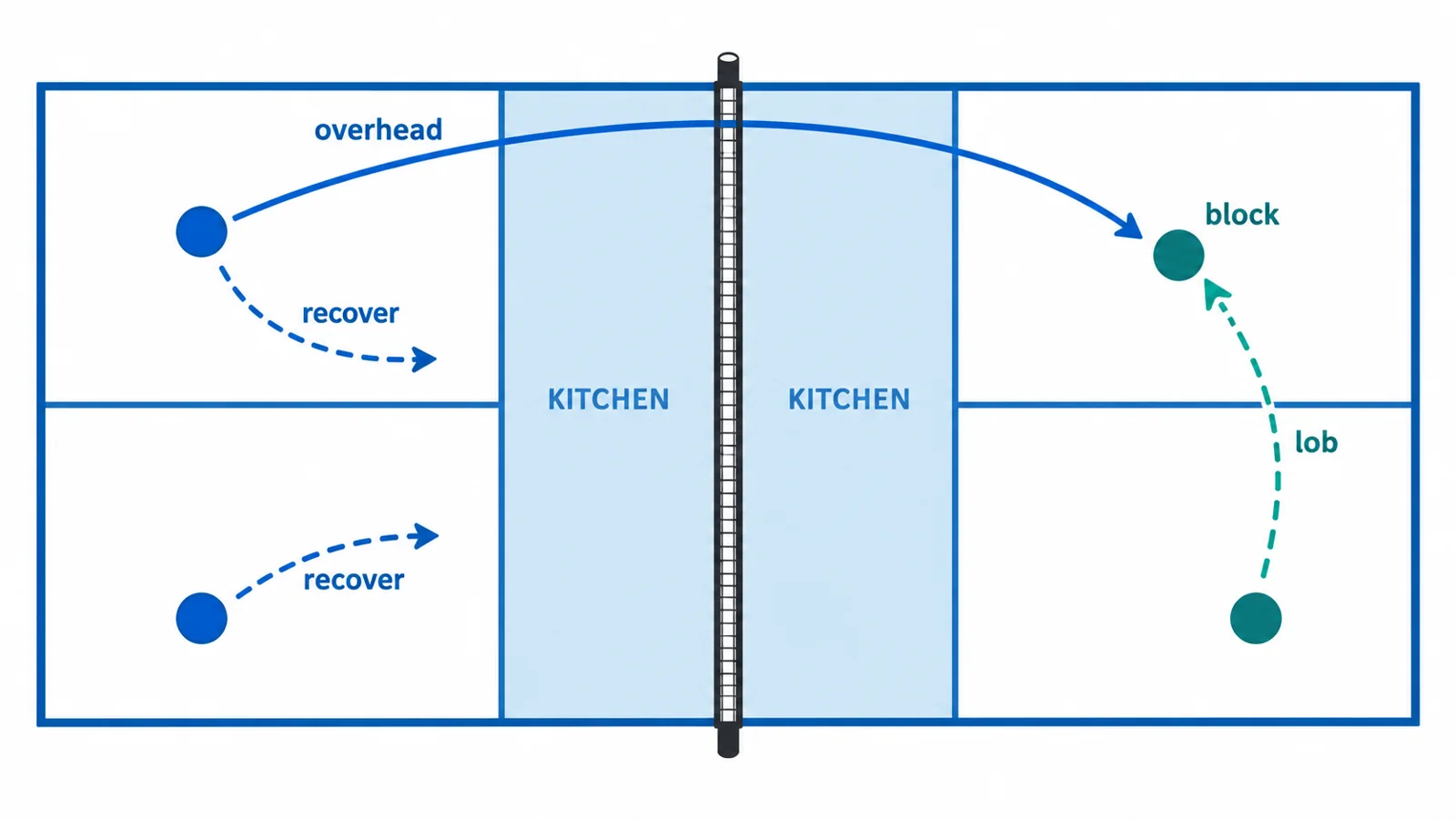
The first option is a compact block. Relax the grip, keep the paddle face stable, and meet the ball in front without a large backswing. Your target is often the opponent’s kitchen, not the baseline. A soft reply can force the next ball upward and give your team time to recover.
If the ball arrives low, do not swing harder. A low contact point usually needs a defensive answer. If it rises above your comfortable contact zone, a controlled drive may be possible, but only when your feet are set.
Example: during 20 feeds, count balls that cross the net and land low enough to prevent an immediate attack. If 13 qualify, the practice rate is 13 ÷ 20 = 65%. That is a training measure, not a match statistic.
When to use a counter-lob
A counter-lob buys time when the attacker has moved deep or committed forward. Aim high and deep, preferably toward the backhand corner, while leaving room inside the lines. A short lob gives away an easy overhead; a long one goes out. The shot works best when disguised from a dink or soft block rather than used as a panic button.
After the ball goes up, communicate. One player tracks the ball and the other covers the middle. Once the opponent lets it bounce, move together toward the kitchen line.
Drills for overhead defense
Ten-ball block series
Have a partner feed ten controlled overheads. Block five to the forehand-side kitchen and five to the backhand-side kitchen. Record low, playable replies and restart if the feed becomes unsafe.
Read, defend, recover
The feeder alternates a soft lob and an overhead. Split step on contact, turn instead of backpedaling, stop before the reply, then recover with your partner. In four sets of eight balls, note both the defensive result and whether your team returned to a shared line.
Counter-lob choice
The feeder gives a deep overhead from two angles. Use a block when balanced and a counter-lob when pulled wide. At 12 balls, 9 correct decisions equal 9 ÷ 12 = 75%; review the three misses by decision, contact, and footwork.
Common mistakes
- Standing too close to the kitchen.
- Swinging at full speed from a low contact.
- Watching the ball while the feet stop.
- Backpedaling and falling away.
- Letting both partners chase the same lob.
The reliable sequence is simple: read early, create space, defend compactly, call the ball, and recover together.