Pickleball Singles Footwork: Move, Recover, and Control the Court
A practical pickleball singles footwork guide covering split steps, five movement patterns, center recovery, approach lanes, lob defense, and drills.
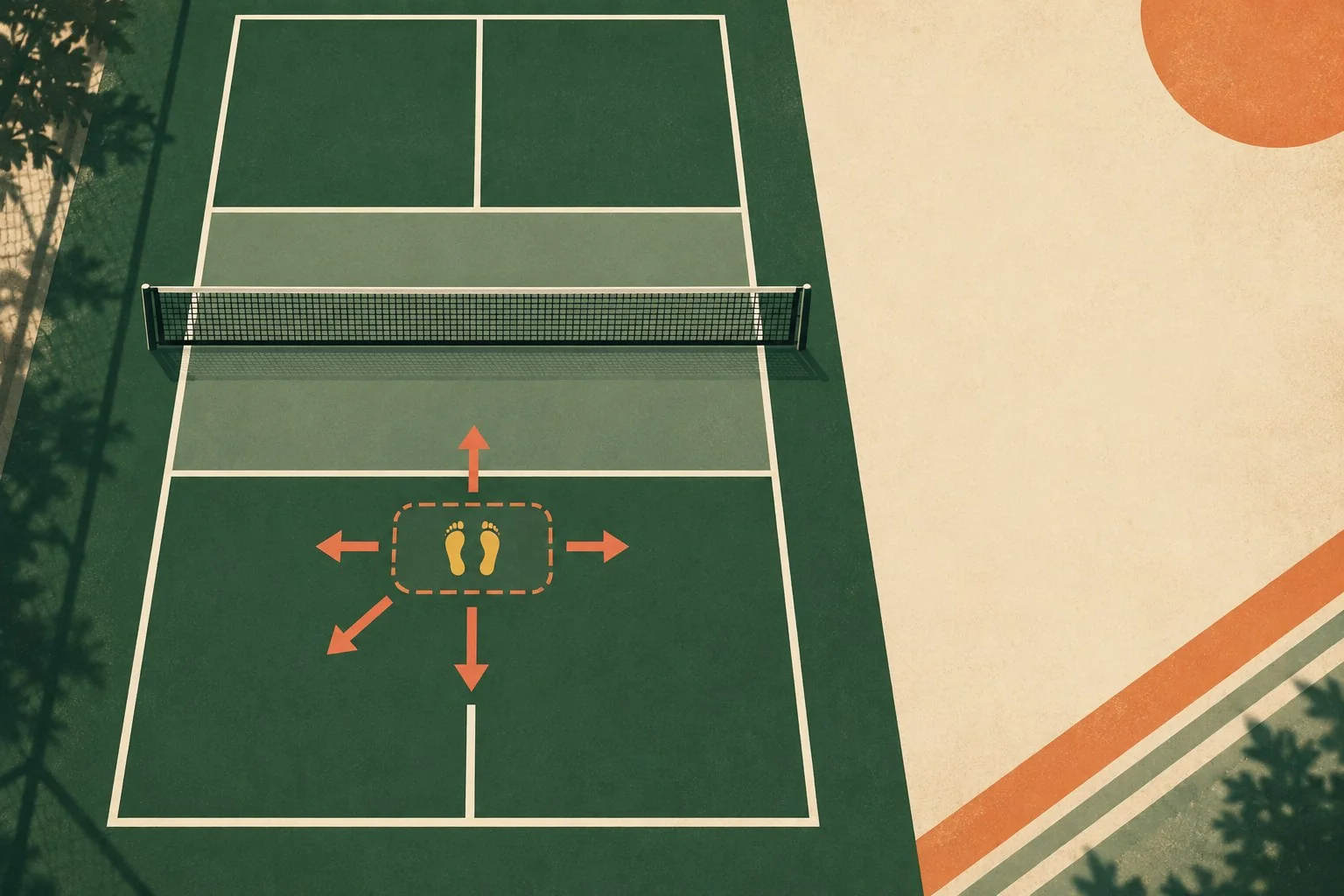
Singles pickleball is won with court coverage, not frantic running. A reliable footwork system helps you arrive balanced, recover before the next contact, and make the opponent hit into a smaller court. The essential pattern is simple: split step, move with the right footwork pattern, strike, then recover toward a useful center position.
Why singles footwork is different
In doubles, a partner shares the court. In singles, every wide ball, short ball, and lob belongs to one player. That makes movement a tactical choice rather than a race. Your goal is to reach the ball with enough balance to choose a shot, then return to a position that covers the opponent’s most likely reply.
The split step is the foundation. Make a small two-foot hop that lands as the opponent makes contact. Land on the balls of your feet with soft knees and the paddle ready. This brief reset keeps you from committing too early and lets you push left, right, forward, or back. If you land before the opponent strikes, you may become flat-footed; if you land late, the ball has already chosen your direction.
Five movement patterns to practise
Use a lateral shuffle for balls within roughly two or three steps of your center. Keep the hips facing the net, take short steps, and let the trailing foot close the gap without crossing. The shuffle allows a mid-course correction if the opponent changes direction.
When a ball pulls you farther wide, use a crossover step to cover ground faster. Cross the trailing leg in front, then return to shorter shuffle steps as you approach the ball. Do not wait until you are fully back at center before resetting. A useful checkpoint is to get one foot across the center line and split as soon as the opponent is about to hit.
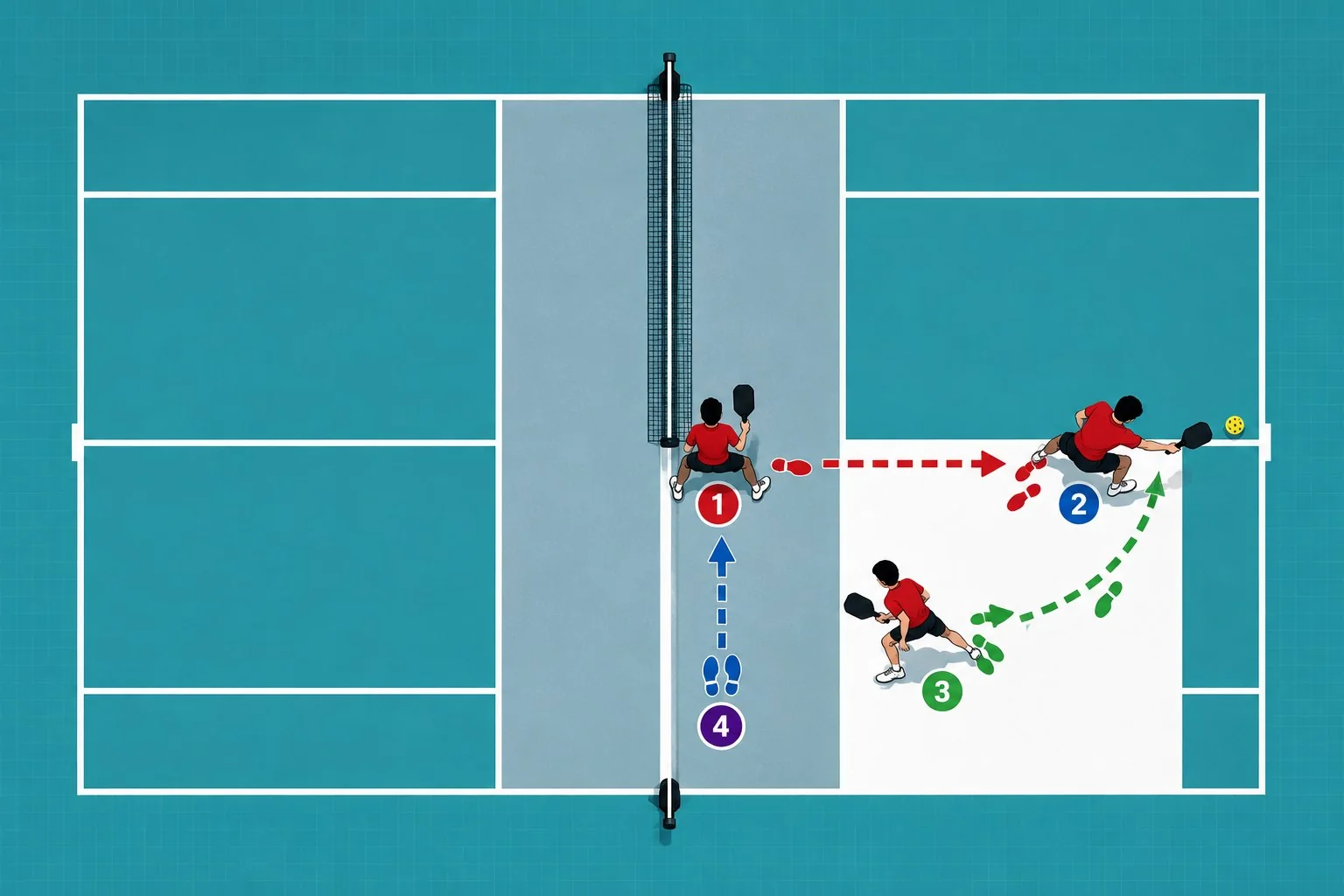
The forward approach belongs to a short ball, a deep or off-balance opponent, or a shot that gives you a clear chance to advance. Move through the middle when the opponent still has crosscourt options; that lane closes more angles than an approach straight down the line. At the transition zone, split step and decide whether the next ball can be attacked or needs a reset.
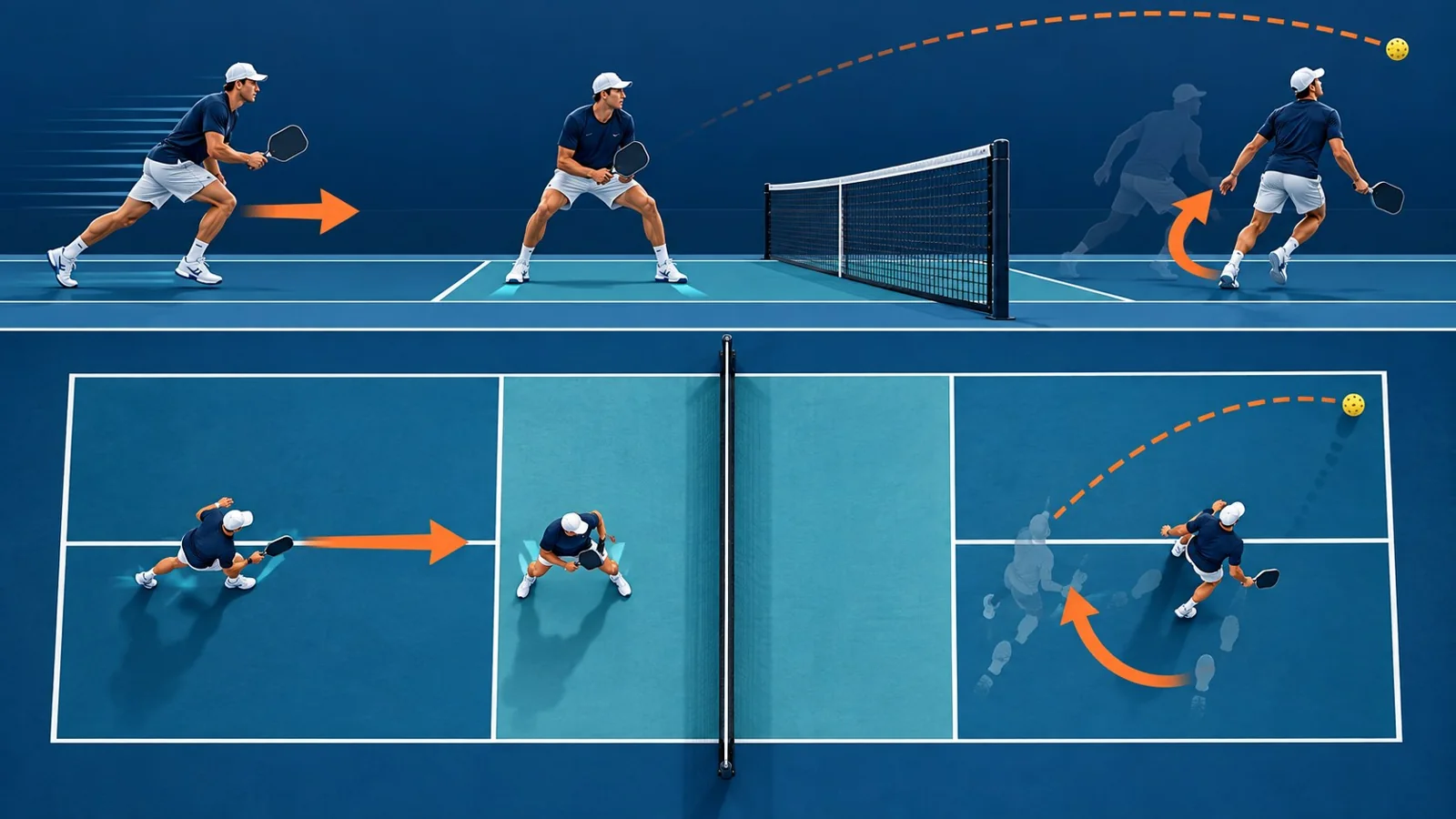
For a lob, pivot and run rather than backpedaling. Open the hip, turn, and sprint while keeping the ball in view. Backpedaling is slower and makes an overhead or emergency reset harder. After the retrieval, recover immediately instead of watching the result.
Choose a recovery position
The center of the baseline is the default because it gives similar access to both corners and leaves the opponent less open court. Center does not mean a painted spot. Shift it slightly toward the side your last shot has closed, and adjust again when the opponent’s position changes.
After a wide shot, start recovery while the follow-through is finishing. If you wait to admire the ball, the opponent gets time to hit before you are organized. When the opponent is deep, off balance, or forced to hit upward, you may advance. When your ball is neutral and the opponent has time, recover instead of gambling on a rushed approach.
Efficient movement saves energy. Short recovery lines, controlled shuffles, and an occasional deliberate stutter step are more useful than dramatic sprints. Keep the hips neutral until the final direction is clear; early rotation can reveal where you intend to move.
A practical training sequence
Begin with two minutes of split steps on an empty court, timing each landing to an imagined contact. Add lateral shuffles from center to each sideline and back, then practise crossover recovery with one foot crossing center before the next split. Next, feed a short ball, approach through the middle, split in the transition zone, and recover after the shot.
Finish with lob retrievals. Start near the kitchen, pivot toward a tossed ball, run to a safe overhead position, and return to the baseline center. Count a repetition only when the recovery is complete. Three rounds of eight quality repetitions build a clearer habit than a long session performed while tired.
Singles footwork becomes dependable when movement has a trigger: split on contact, shuffle for short width, cross over for distance, approach on a real opening, and retreat with a pivot. Practise the sequence until your feet reach the next position before panic chooses it for you.