Third Shot Strategy: Drop, Drive, or Lob?
A practical decision guide for choosing the drop, drive, or lob after the serve and return in doubles pickleball.

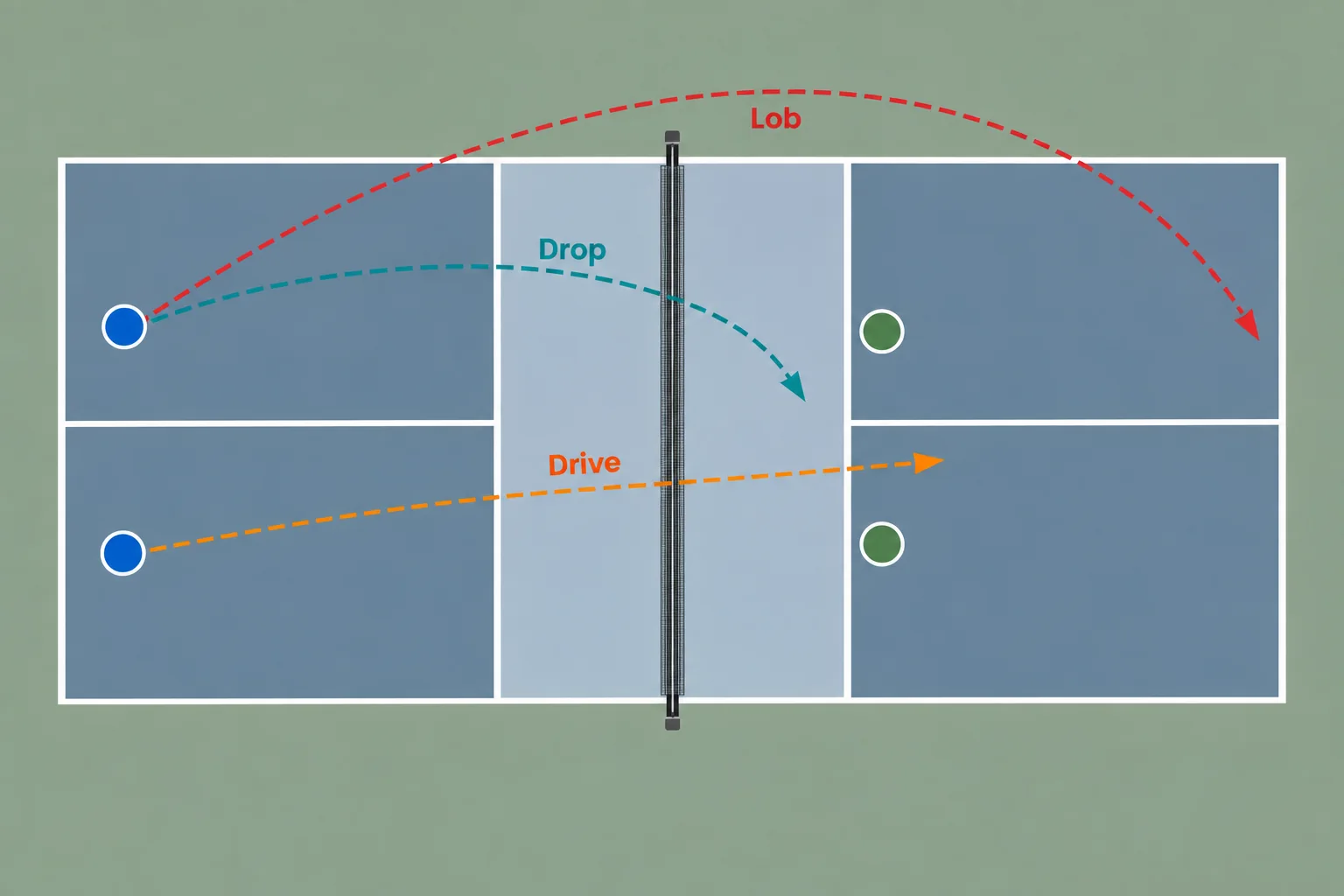
Third shot strategy starts with a read, not a preset swing. After your serve and the opponent’s return, check the ball’s depth, bounce height, your balance, and the opponents’ position. A deep return while you are moving backward usually calls for a drop. A short, high return with your feet set may invite a drive. A lob is a change-up, not a default answer.
What is third shot strategy in pickleball doubles?
The third shot is the serving team’s first ball after the serve and return. Because the receiving team can often reach the kitchen line first, the serving team is trying to close a positional gap rather than win the rally immediately.
That makes shot choice and movement inseparable. After a drop, advance behind the ball and use a split step as the opponent prepares to hit. After a drive, expect a block or counter and stop in the transition area instead of running blindly forward. A third shot that lands well but leaves both players frozen has solved only half the problem.
When should you hit a third-shot drop?
Choose the drop when the return is deep, your contact is low, or the opponents are already stable at the kitchen. The ball needs enough arc to clear the net and descend before the non-volley zone, where it becomes harder to attack.
Example: the return bounces close to your baseline, your weight is drifting backward, and both opponents are waiting forward. A hard drive from that position gives them a comfortable counter if the ball rises. A soft drop buys time for you and your partner to take two or three steps forward, then split step before the next contact.
A short return can still be a drop if it stays low or pulls you wide. Do not confuse a shorter distance with an easy attacking ball; balance determines the choice.
When does a third-shot drive make sense?
Drive when the return is short or high, your feet are set, and you can contact the ball in front of your body. Aim low at the opponent’s feet or through the middle, where a rushed block may float.
Use a simple test. If the ball lands about a metre inside your baseline, rises near waist or net height, and your weight is moving forward, you have a drive window. If the same ball catches you while you are retreating, the window has closed and a drop is safer.
A drive does not have to win outright. It can force a high block that your partner takes while you move into the next position. Agree who goes forward before training this pattern.
Is a third-shot lob ever the right choice?
Sometimes. A lob can work when both opponents are leaning forward, standing close to the kitchen, or expecting a low ball. Play it high and deep enough to make them turn, while accounting for wind: a headwind shortens the flight, while a tailwind carries the ball faster.
Treat the lob as a surprise. A shallow lob is an easy overhead. When the read is unclear, the controlled drop usually offers a larger margin.
How can you train third shot strategy?
Have a partner feed deep, medium, and short returns in random order. Call the read before swinging, then apply this decision tree:
- Deep return and backward movement: hit a drop.
- Short or high return with stable feet: hit a drive.
- Low bounce or poor balance: hit a drop.
- Both opponents crowded at the kitchen and leaning forward: occasionally use a lob.
Run the drill for 10 minutes. Record decisions by zone, not just makes. If five of eight drives from the deep zone float high, the correction is shot selection or contact height, not extra power.
Common third-shot mistakes to avoid
- Always dropping: a high, short return may be a clear drive.
- Always driving: a deep ball hit while retreating is easy to counter.
- Stopping after contact: move with the shot and prepare before the opponent strikes.
- Aiming the drop at the kitchen line: land it in the kitchen, not on the line, when possible.
- Ignoring the score: at 9–9, use the option you can repeat under pressure rather than a hopeful winner.
Third shot strategy FAQ
What should beginners learn first?Build a repeatable drop from the deep court first. Add the drive for short, high returns, then use the lob as a change-up. The goal is a readable decision process, not one favourite shot.
How do I know if a return is too deep to drive?If the bounce pushes you behind the baseline or forces a backward contact, treat it as deep. A ball you can meet while moving forward, between knee and chest height, may be a drive.
Why do my drives get attacked?The ball may be rising too much, you may be striking while moving backward, or you may be stopping after the swing. Lower the target, choose a drop when balance is poor, and move forward behind the ball.