How to Play Pickleball Doubles: A Beginner Guide
A practical beginner guide to pickleball doubles rules, scoring, positioning, partner communication, shot selection, and drills.

If you are learning how to play pickleball doubles, start with three habits: know the score, move with your partner, and reach the kitchen line without rushing. Doubles is played by two teams of two on a 20-by-44-foot court. The rules are simple, but positioning decides many rallies before a powerful shot is even needed.
What are the basic pickleball doubles rules?
Each rally begins with a serve from behind the baseline, hit diagonally into the opposite service court. The serving team can score under traditional side-out scoring. Games usually go to 11 points, and a team must win by two.
The first two shots must bounce: the serve, then the return. Only after those bounces can either team volley. This is the double-bounce rule. For example, if Team A serves and Team B returns, Team A must let that return bounce before hitting the third shot in the air.
The kitchen, formally the non-volley zone, extends 7 feet from the net on each side. You may step into it after the ball bounces, but you cannot volley while touching the zone or its line. Your momentum cannot carry you into it after a volley either.
How does pickleball doubles scoring work?
Doubles scores are commonly called with three numbers: serving-team score, receiving-team score, and server number. A call of 0–0–2 means the game has just started and the second server is serving. The opening service sequence uses a second-server designation so the first serving team does not receive two server turns before the other team serves.
After a side out, both teammates normally get a service turn. The current server keeps serving when the team wins a rally, and teammates switch sides after each point won on serve. When the second server loses a rally, service passes to the other team.
Use the score as a positioning check. If your team’s score is even, the player who began on the right side returns to the right; with an odd score, that player starts on the left. This simple reference prevents many rotation mistakes.
Where should players stand in doubles?
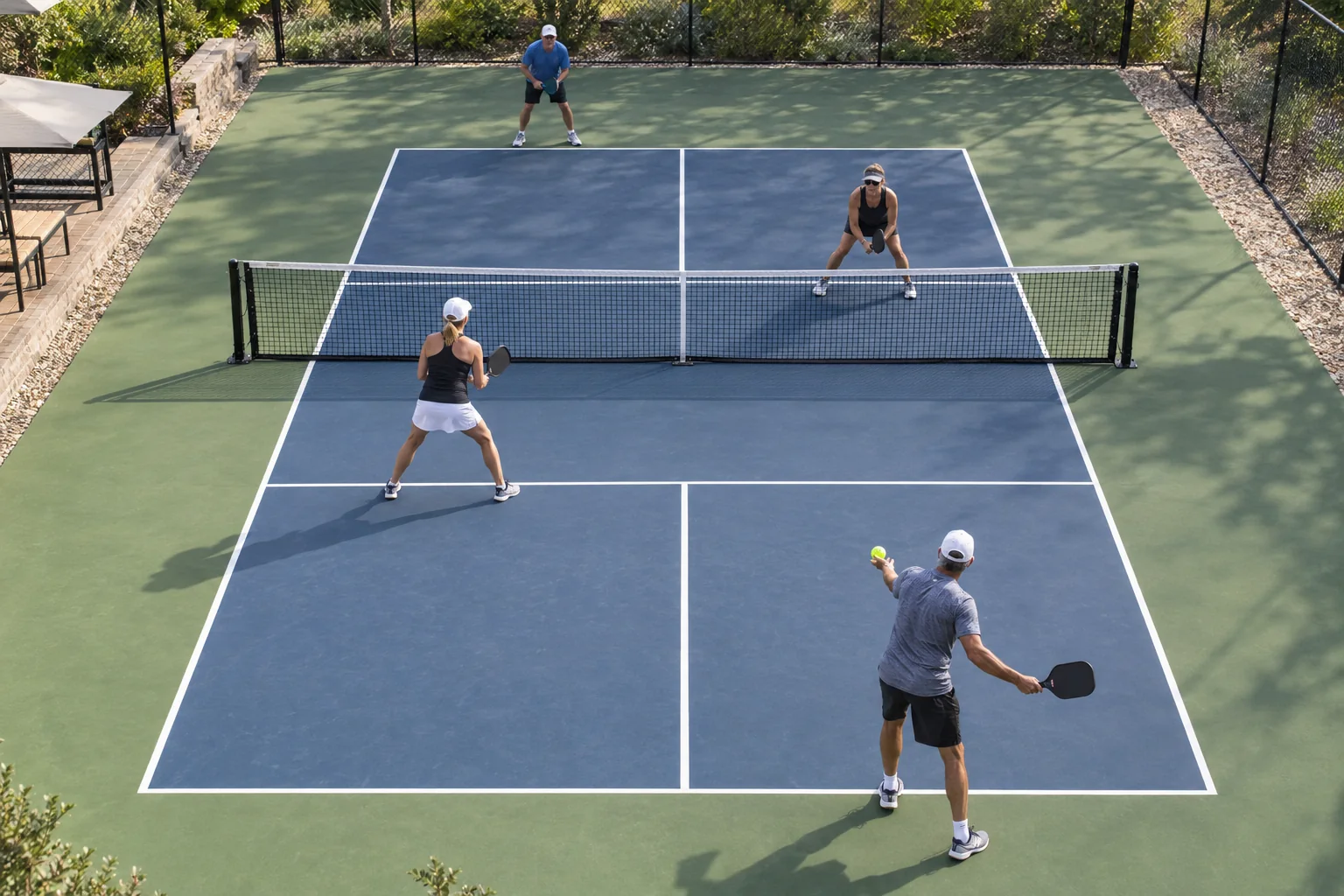
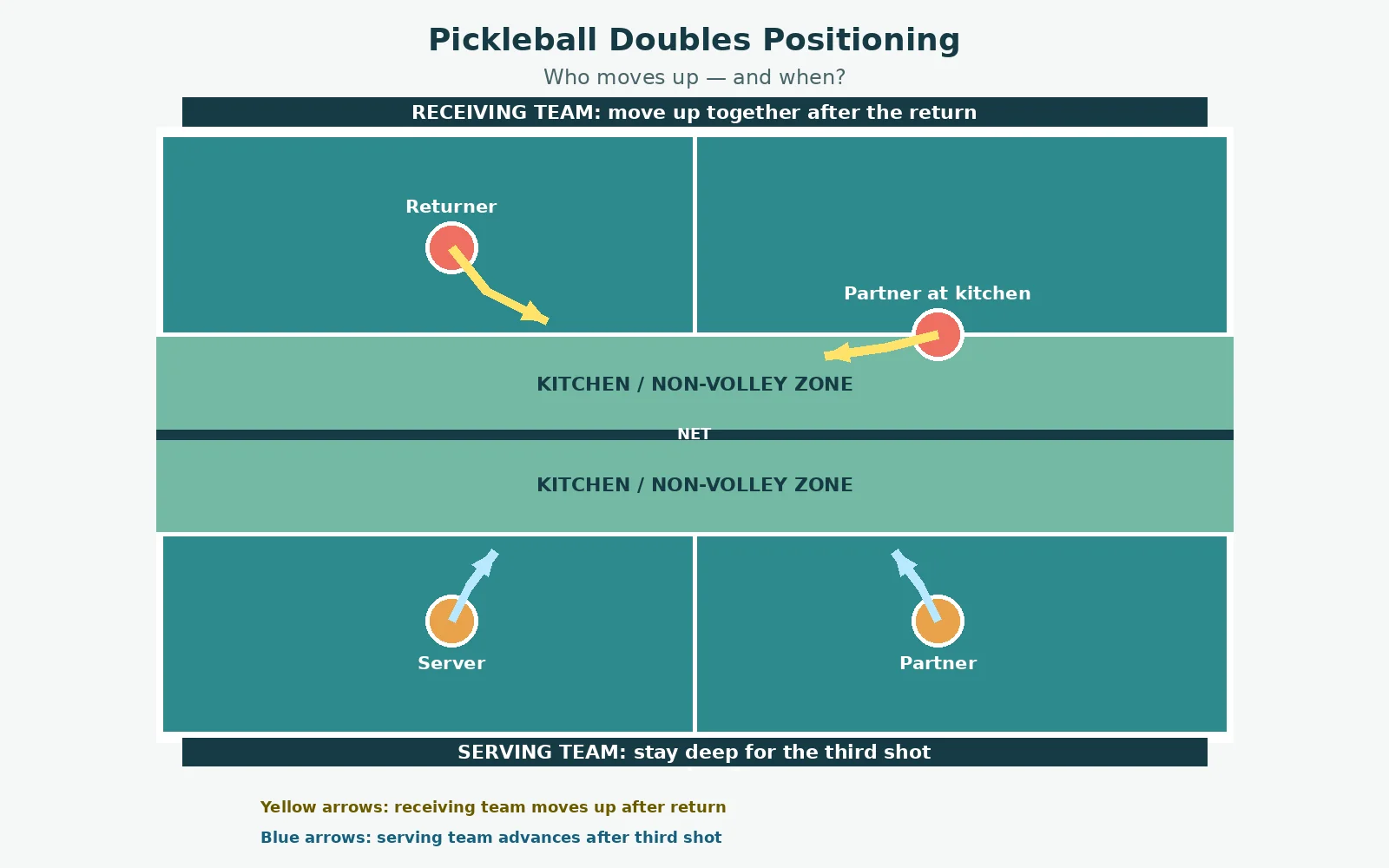
The serving team starts behind or near the baseline. The receiver also begins deep enough to handle the serve. The receiver’s partner usually starts at the kitchen line, so the receiving team already has one player in the strongest court position.
After returning the serve, move forward and join your partner. Do not sprint blindly. Use checkpoints: move, split step, get balanced, then take the next step. A return that lands deep gives you more time to advance; a short or weak return may require a defensive pause.
Both partners should move as a unit. If one player moves toward the kitchen, the other should close the gap. If a partner is pulled wide, shift toward the middle to protect the likely reply. Staying aligned is more useful than memorizing an exact distance between teammates.
Who takes the middle ball?
Usually, the player with the forehand in the middle takes a neutral ball because that side offers more reach and control. Agree before the serve. A quick “middle is mine” removes hesitation. If the ball is clearly traveling toward one player’s half, that player takes it even when the other player has a stronger forehand.
When should doubles players drop, drive, or reset?
The third shot helps the serving team move from the baseline toward the kitchen. A soft drop arcs into the opponent’s kitchen and gives your team time to advance. A drive travels faster and can pressure an opponent, but it is safer when the ball is high enough to attack and directed at an uncomfortable target.
Use a reset when you are stuck in the transition area between the baseline and kitchen. A soft ball that lands in the opponent’s kitchen can slow the rally and buy time to recover. Avoid attacking a low ball from below net height; players at the kitchen usually have the better angle.
A practical decision rule is simple: high ball above comfortable contact height, consider a speed-up; low ball near your feet, reset; balanced ball with time, advance behind a controlled shot. The rule is not automatic, but it keeps beginners from attacking while off balance.
Which pickleball doubles drills help beginners?
Lateral kitchen drill
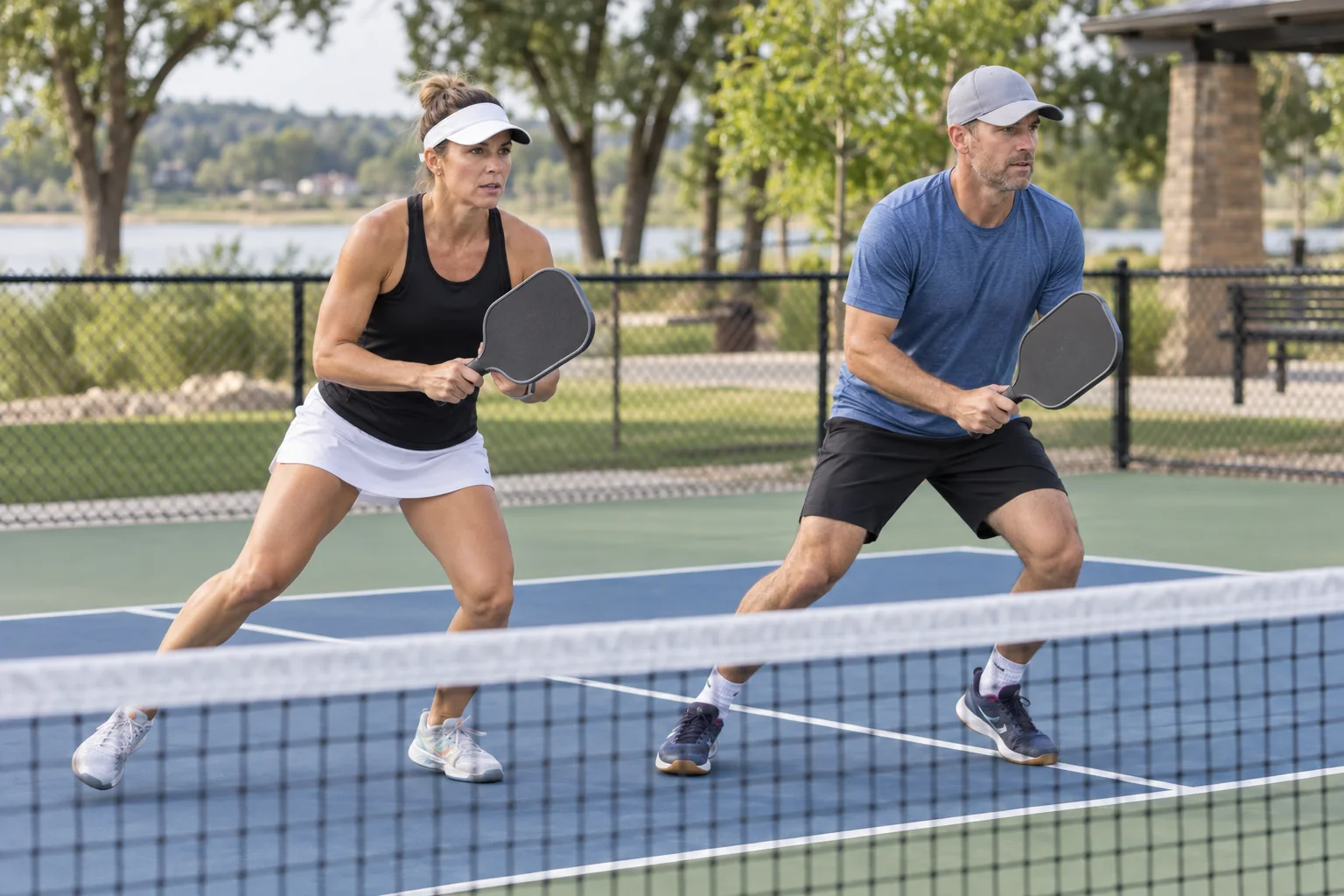
Start opposite your partner at the kitchen line. Exchange controlled volleys while moving together from one sideline toward the other, then back. Keep your chest and paddle facing the net. Begin with 10 slow exchanges, then repeat at a quicker pace. The goal is synchronized movement, not maximum speed.
Third shot and advance
Play a point where one player hits the third shot and the partner moves forward behind it. Advance only when the drop is low or the drive is controlled. Run 10 repetitions, then switch roles. Count how many times both players reach the kitchen in balance rather than counting only winners.
Middle-ball call drill
Feed balls toward the center and require the partners to call “mine” or “yours” before moving. Do 20 feeds. If both players move on the same ball, reset the repetition. This trains communication under a small amount of pressure.
What mistakes should doubles beginners avoid?
- Staying at the baseline after a safe chance to advance.
- Leaving a large gap between partners.
- Both players chasing the middle without a call.
- Attacking from a low transition ball.
- Forgetting the server number.
- Entering the kitchen during a volley.
When a rally feels chaotic, simplify the next point. Return deep, move together, keep the paddle up, and choose a high-percentage shot. In a 10-point practice game, record how often your team loses a rally to positioning rather than shot execution; if six losses come from standing too far back, the next session should emphasize movement, not harder drives.
Doubles pickleball FAQ
What does 0–0–2 mean?
It means the serving score is zero, the receiving score is zero, and the second server is serving. The opening sequence starts with the second-server designation.
Can you stand in the kitchen?
Yes. You may stand there when the ball has bounced. You may not volley while touching the kitchen or its line, and you must avoid being carried into it by momentum after a volley.
Should both partners go to the kitchen?
Usually, yes, when the team can advance safely. Move together so opponents cannot attack a large gap between you.
Who covers the middle?
Agree before the rally. In many teams, the player with the forehand in the middle takes neutral middle balls, while the player whose side the ball is moving toward handles a clearly directed shot.