Pickleball Court Fence Maintenance: What to Check
Pickleball court fence maintenance protects players and keeps balls contained. Inspect mesh, posts, gates, sharp edges, corrosion, and loose fittings with this checklist.
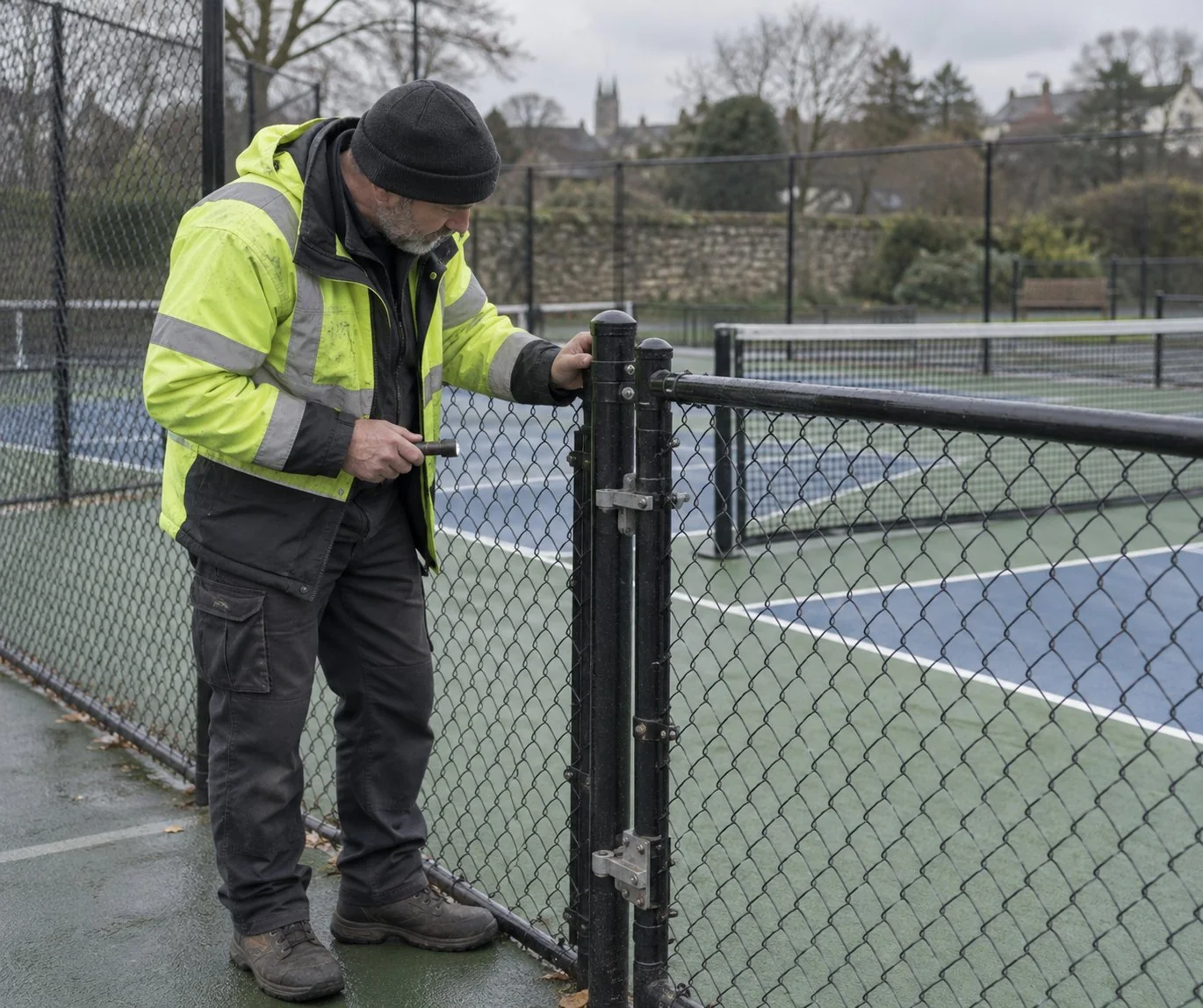
Pickleball court fence maintenance starts with a walk around the entire perimeter, not a quick look at the gate. Check loose mesh, bent posts, sharp wire, damaged padding, corrosion, and gaps where a ball or a foot could pass. A fence can still stand upright while one failed fitting creates a hazard.
Where should an inspection start?
Close the court before a hands-on inspection. Walk the outside first and look for leaning posts, lifted anchors, torn mesh, and sections pushed out by wind or impact. Then inspect the inside without leaning your body against the fence. Pay special attention to corners, gate hinges, and the area behind the baseline where balls strike repeatedly.
Run a visual check from several angles. A bright reflection may hide a broken wire, while a shadow can make a gap look smaller. For a practical example, mark a 10-centimetre opening beside a post and compare it with the ball size and nearby foot traffic; the measurement documents the problem, but it does not by itself decide every repair requirement.
How can loose mesh create problems?
Mesh that rattles or bows outward may indicate failed ties, stretched sections, or a damaged frame. Do not pull hard to test it. Look for missing fasteners and compare the tension with an undamaged section nearby. A loose lower edge is especially worth recording because players may step close to it while retrieving a ball.
Inspect protective coverings too. Foam around a post should remain secured and free of exposed hard edges. Tape that is peeling can catch clothing or hide corrosion underneath. Replace a temporary covering rather than treating it as a permanent repair.
What about gates and access points?
Open and close each gate slowly. The latch should engage without forcing, the hinges should not drag, and the gate should not swing into the playing area unexpectedly. Check the gap beneath it and the threshold for raised hardware. Keep maintenance tools outside the court before reopening play.
If a gate needs a shoulder push to close, record that specific fault instead of simply writing “gate issue.” A useful record includes the court number, date, location, weather, photograph, and action taken. After repair, repeat the same movement and confirm that the latch holds.
When should the court remain closed?
Keep players out when wire ends are sharp, a post is unstable, a gate cannot latch, or mesh has detached into the playing space. Do not ask players to “be careful” around a known defect. Isolate the area and arrange qualified maintenance when the repair involves anchors, structural posts, electrical equipment, or work at height.
Small surface rust may call for monitoring, but spreading corrosion at a post base deserves closer attention. Do not paint over a weak joint before documenting it, because cosmetic coverage can conceal the progression.
A repeatable maintenance record
Use the same route each time: corners, baselines, gates, posts, lower mesh, then padding. Record findings after storms and after events with heavy traffic. If the same fitting loosens twice in three inspections, the pattern supports a more durable fix than repeated tightening.
Reopen the court only after the defect is removed or the affected section is safely isolated. Good fence care is quiet work, but it prevents a loose edge or unreliable gate from interrupting play at the worst moment.