Pickleball Doubles Strategy: Play as One Team
A practical doubles guide to kitchen positioning, deep returns, third-shot transitions, middle coverage, and clear partner calls.

pickleball doubles strategy starts with a shared plan, not a collection of heroic shots. The pair that reaches the kitchen together, protects the middle, communicates early, and waits for a ball they can attack will usually control more rallies. Start with deep serves and returns, then use the third shot to move forward without breaking formation.
What is the best pickleball doubles strategy for beginners?
A reliable beginner framework has three parts: positioning, patience, and partnership. Positioning puts both players near the non-volley zone when the rally allows it. Patience prevents low defensive balls from becoming reckless attacks. Partnership keeps the two players connected so a gap does not open between them.
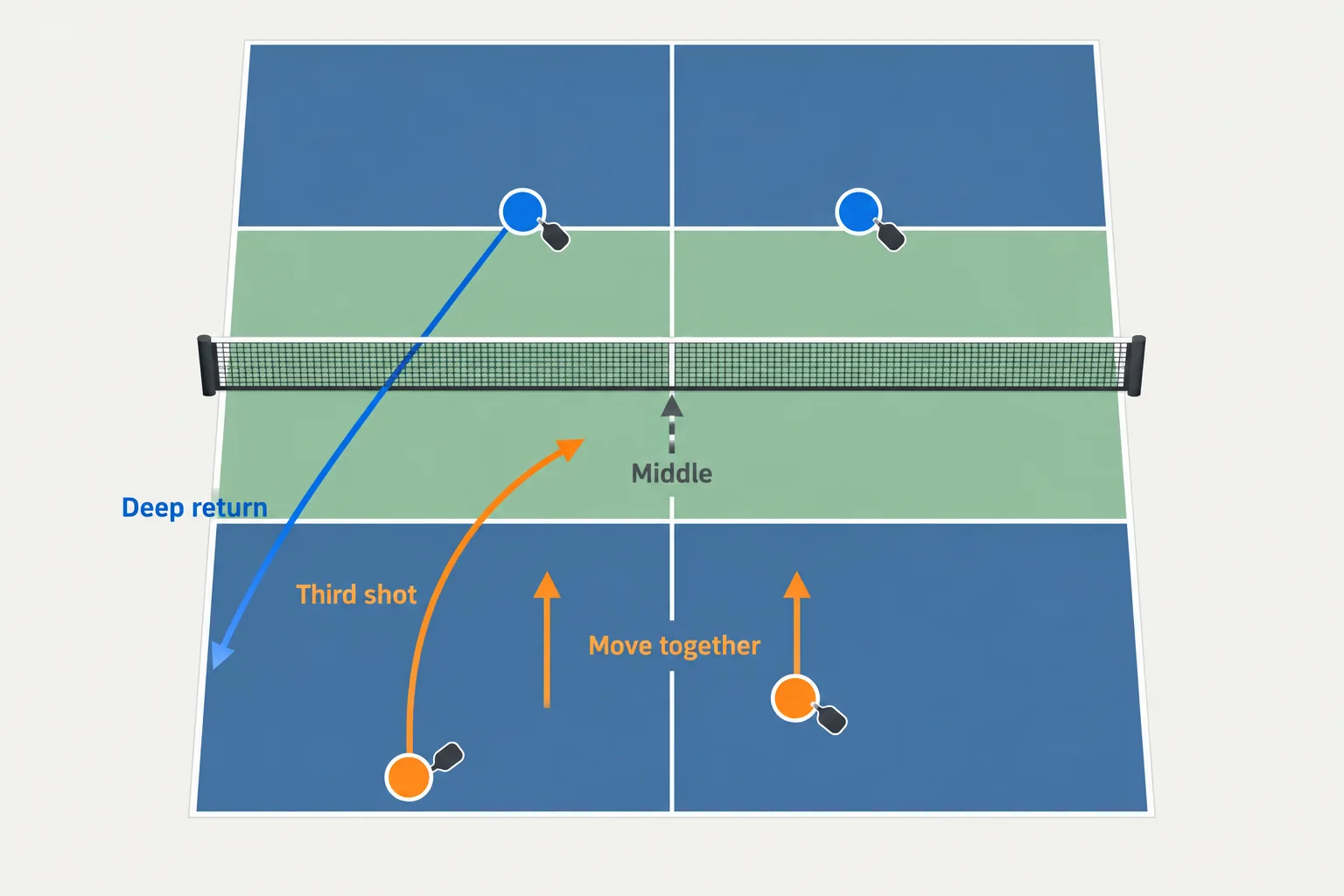
The serving team begins at a disadvantage because the serve and return must each bounce before either side can volley freely. The receiving team can return deep and advance while the serving team prepares its third shot. That is why the first goal is not to finish the point from the baseline. It is to survive the transition.
A useful sequence looks like this: serve deep, read the return, play a controlled third shot, advance in small checkpoints, split step, and get ready for the next ball. If the third shot lands short and low, keep moving. If it floats high, pause rather than charging into an easy attack.
How should doubles players position at the kitchen?
The kitchen line, also called the non-volley zone line, is the strongest general position in doubles. From there, players can take balls early and make opponents hit upward. Both partners should move as a unit. When one player advances, the other closes the same distance; when one is pushed wide, the partner shades toward the middle.
Do not treat the centre line as an equal split of responsibility. The player with the forehand in the middle often has the better angle, but the pair should agree before the point. A simple call such as “forehand middle” removes hesitation. If both players wait, the ball lands between them. If both swing, the team creates a different problem.
The transition zone between the baseline and kitchen is temporary territory. Stand there only while moving through it, keep the paddle in front, and use a split step before the opponent contacts the ball. A player who stops in that area is exposed to balls at the feet.
How do you use the third shot in doubles?
Choose the third shot from the height of the ball, your balance, and the opponents’ position. A soft drop is useful when the receiving team is established at the kitchen and you need time to advance. A drive can work when the return is short, the ball is at a comfortable height, or an opponent is out of position.
For example, if a return bounces about 1 metre inside your baseline and you are balanced, a controlled drive toward the weaker player’s feet may be practical. If the return pushes you deep and low, forcing a hard drive usually creates a high ball, so a higher-margin drop or reset is safer. The decision changes with the contact, not with a fixed rule that says every third shot must be soft.
After contact, move behind the ball’s direction and stop before losing balance. The fourth shot matters. If the opponents answer the drop softly, keep advancing; if they attack, absorb the pace and reset the ball into the kitchen rather than swinging harder from a poor position.
How should partners cover middle balls?
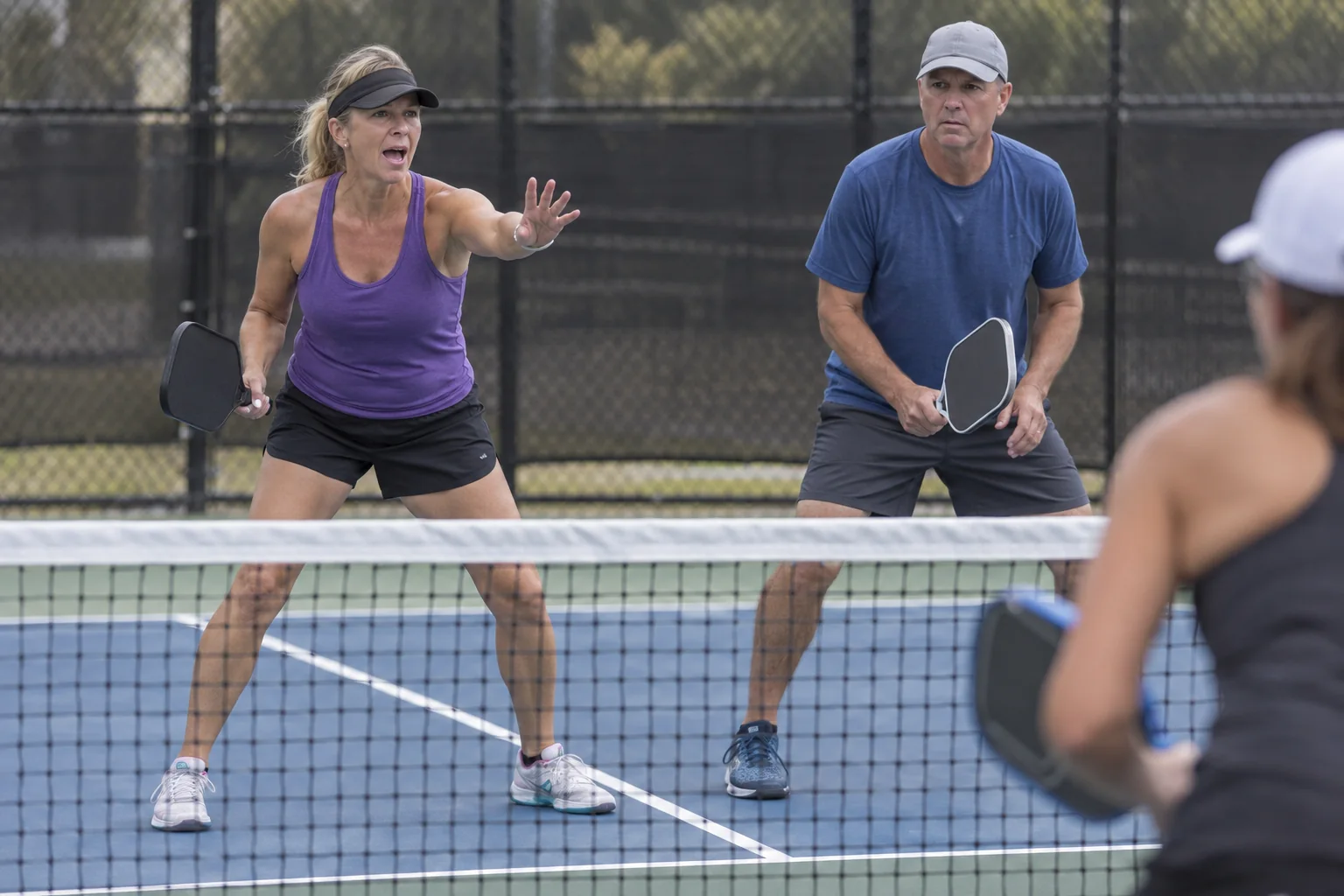
Decide the middle rule before the game. The player whose forehand faces the centre usually takes a neutral middle ball, while the other player protects the outside lane. This is a starting rule, not a reason to ignore a ball that clearly belongs to the partner’s side.
Use early calls. “Mine” claims the ball, “yours” transfers responsibility, and “out” warns before the bounce. Keep calls short because long explanations arrive too late. Between points, adjust one detail: target the backhand, cover the lob, or slow down the next exchange.
A five-second check before serving can prevent several errors: agree who takes the middle, whether the serving team will drop or drive, who covers a lob, and whether the pair will stay or switch after the return. That small routine is easier to repeat than improvising after the ball is already moving.
When should you speed up, reset, or lob?
Speed up a ball that rises above the net and arrives when your feet are stable. Aim at the opponent’s hip, shoulder, or open gap rather than swinging at every ball. Reset when you are defending, moving backward, or contacting below net height; a soft ball into the kitchen can restore time and shape.
Use a lob when both opponents lean forward and you have enough balance to send the ball deep. A short lob is dangerous because it gives the opponent an overhead. A practical drill is to alternate five controlled resets with five attacks from comfortable height, counting only balls that land in the intended area. If 7 of 10 resets land in the kitchen, the success rate is 70%; repeat the set while moving before trusting the shot under pressure.
What mistakes cost doubles teams points?
- Staying at the baseline after a deep return.
- Moving independently instead of matching the partner.
- Standing in the transition zone after the ball has passed.
- Attacking a low ball while retreating.
- Leaving the middle undecided.
- Calling late or not calling at all.
- Chasing a wide ball without covering the next reply.
Fix one error at a time. A team that returns deep, moves together, and avoids free mistakes can improve before adding advanced formations such as stacking.
Pickleball doubles strategy FAQ
Who takes the middle ball in doubles?Usually the player with the forehand in the middle, unless the pair agrees on a different role or the ball clearly favours the other player. Call early.
Should both players rush to the kitchen?Advance together when the shot gives you time. Move in checkpoints after the third shot or a deep return, then split step instead of running blindly into an attack.
Is a third-shot drop always better than a drive?No. A drop offers control from a difficult position, while a drive can pressure a short, comfortable ball. Read height, balance, and opponent position first.
What should beginners practise first?Practise deep returns, coordinated movement, middle calls, and ten controlled third shots before adding complex patterns. Consistency creates the platform for speed and deception.