Pickleball Erne Footwork: Read the Gap and Land Safely
A practical guide to the pickleball Erne: recognize the right ball, move around the kitchen, volley with control, land safely, and recover.
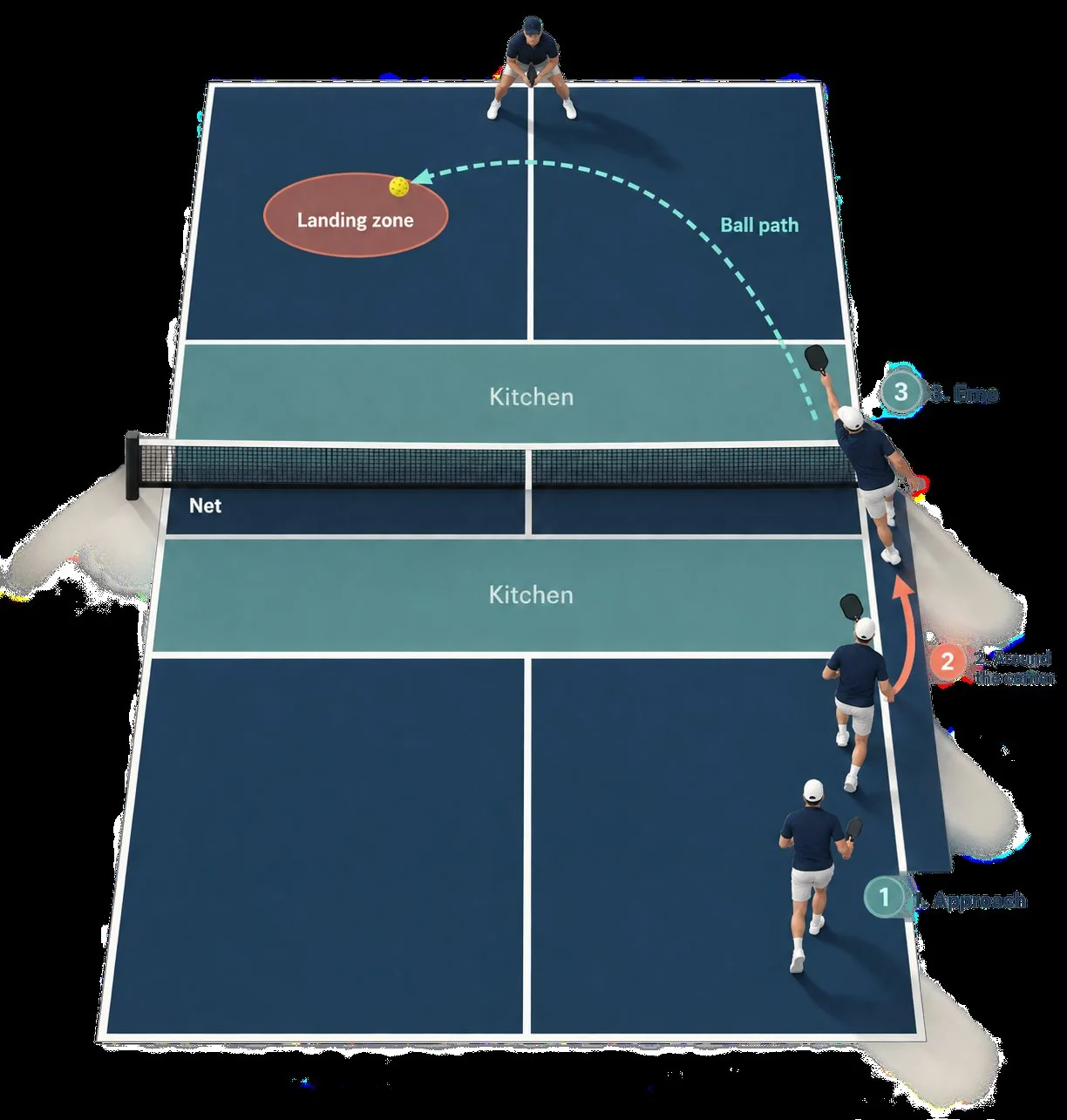
pickleball erne footwork is a selective attacking option, not a jump you should force whenever the ball travels wide. The goal is to recognize a ball that can be reached beside the non-volley zone, move around the kitchen corner, strike in the air, and land outside the zone with balance. Good timing matters more than height or acrobatics.
Read the opportunity before moving
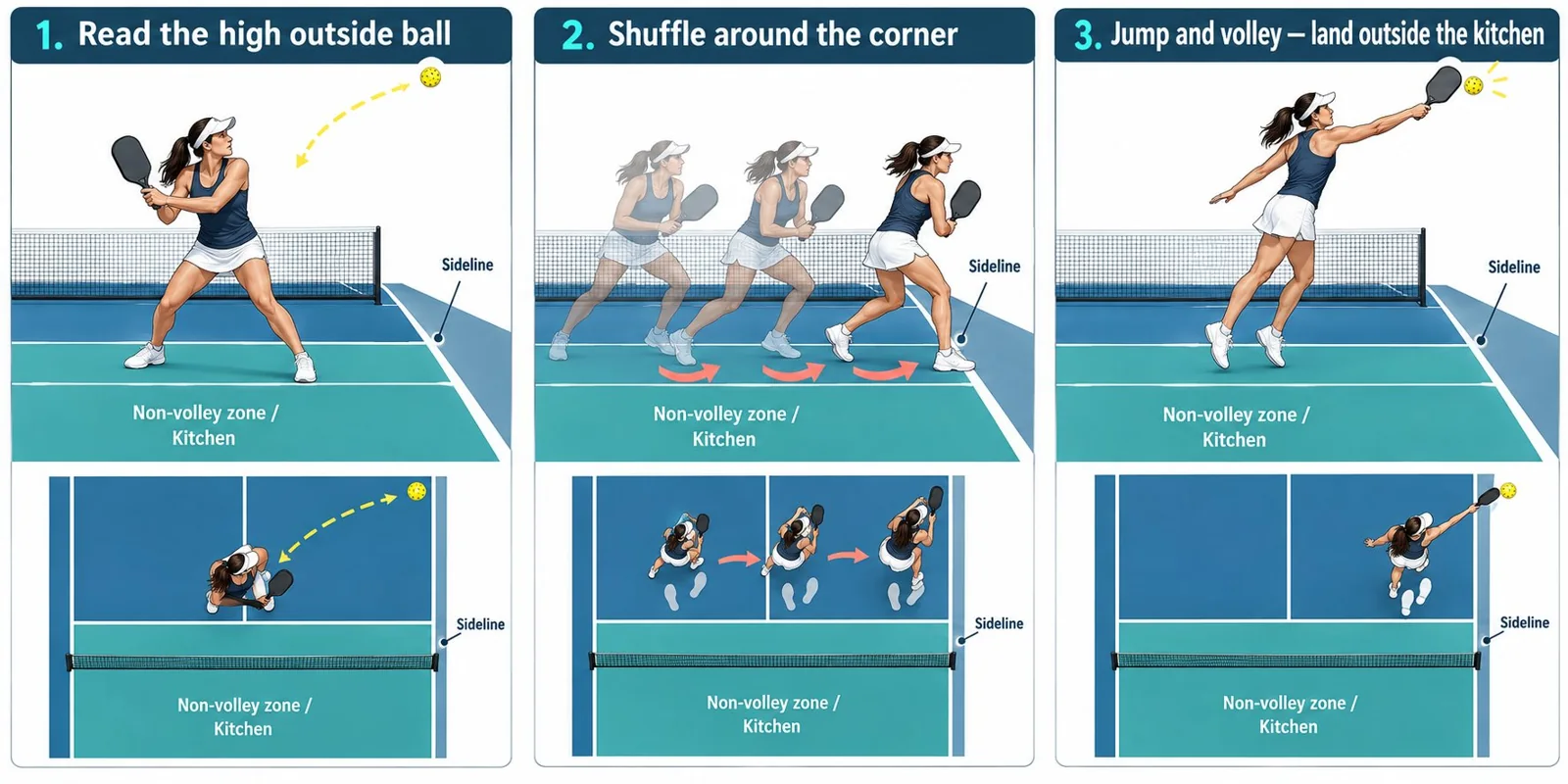
Start with the opponent’s contact and your own position. An Erne becomes more realistic when the ball is high enough to volley, travels toward the outside half, and leaves your opponent expecting a normal crosscourt exchange. You also need a clear landing area beyond the sideline. If the ball is dipping, your feet are late, or the opponent can easily see the move, stay in the rally with a dink or reset.
Do not stare at the sideline and guess. Track the ball first, then glance toward the space where you intend to land. In doubles, know where your partner is before leaving the middle. An aggressive move that exposes the center can create a simpler reply for the opponents than the shot you hoped to win.
The first movement is lateral. Shuffle toward the corner while keeping the paddle in front and the knees soft. Avoid crossing your feet too early; you need a stable base for the final adjustment. As the ball reaches a comfortable height and the path is clear, continue around the kitchen rather than stepping into it.
Set up the jump and contact
The jump should be small and purposeful. Push from a balanced outside position, take the volley in front of your body, and keep the swing compact. You are using the angle created by your position, not trying to swing harder because you are airborne. A controlled punch toward the open court or at the opponent’s feet is often more reliable than a full-power attempt.
Keep your eyes on the ball through contact. The non-paddle hand can help organize the shoulders, while the paddle hand stays relaxed enough to adjust. If the ball drops below a comfortable volley height, let it bounce and return to a neutral pattern. Forcing an Erne on a low ball usually produces a net error or a weak pop-up.
The landing is part of the shot. Land with both feet outside the non-volley zone and absorb the motion with bent knees. Never use the kitchen as a landing platform. If the ball carries you forward, the attempt was not controlled enough; practise the footwork at a slower speed until the landing point is predictable.
Recover with your partner
After contact, do not admire the shot. Recover your balance and read the next ball. If your Erne lands deep or forces a weak reply, move back into a useful position rather than staying stranded beside the sideline. Your partner should slide to protect the middle while you move, then both players should restore spacing once the exchange settles.
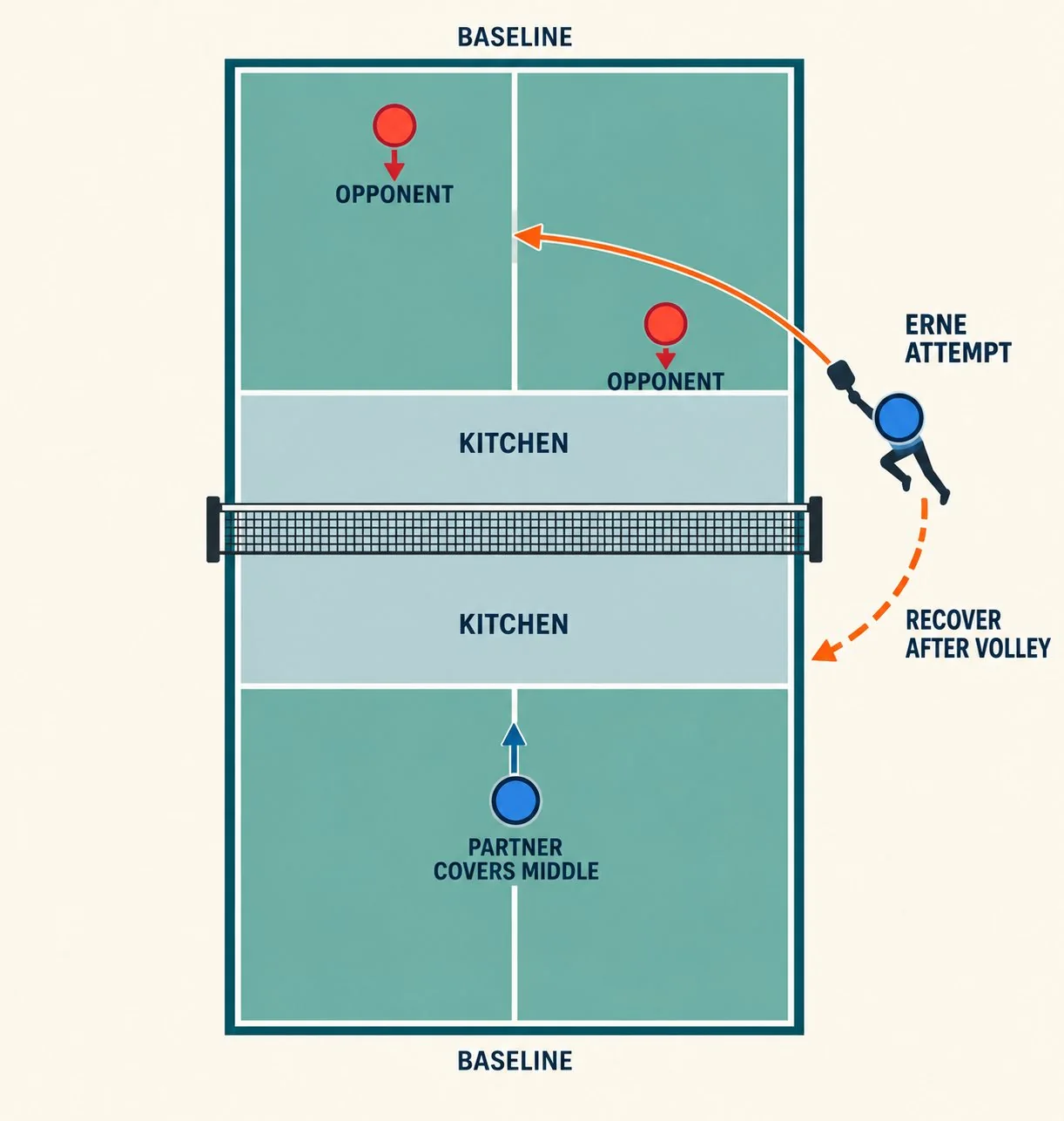
Use an early call such as “Erne” or “I’m out” so your partner knows the middle is temporarily exposed. If the opponent counters quickly down the line, be ready for the next ball instead of assuming the point is over. A missed Erne often becomes worse when the player remains outside the court and cannot recover.
Practice the pattern without forcing it
Begin with shadow repetitions: shuffle to the kitchen corner, check the landing space, make a compact imaginary volley, and recover. Then have a partner feed gentle balls that vary between reachable and unreachable heights. Your job is to call “yes” or “no” before moving. A “no” decision is a successful repetition when it prevents a low-percentage jump.
Progress to a live dink exchange with a clear rule: attempt the Erne only when the ball is high enough, the path is open, and the landing area is safe. Count balanced landings and recovered positions, not winners. Practise both sides, then add partner coverage. The best Erne is the one that fits the rally, protects your body, and leaves you ready for the next shot.