Pickleball Net Setup: Height, Tension, and Portable Court Checks
A practical guide to pickleball net height, tension, alignment, portable frame stability, safety checks, and storage.
A good pickleball net setup does more than make a court look ready. The net needs to sit at the correct height, stay centered, and remain stable while players move around it. A small setup error can change the bounce, create arguments over a close ball, or turn a portable court into a safety hazard.
What to check before you play
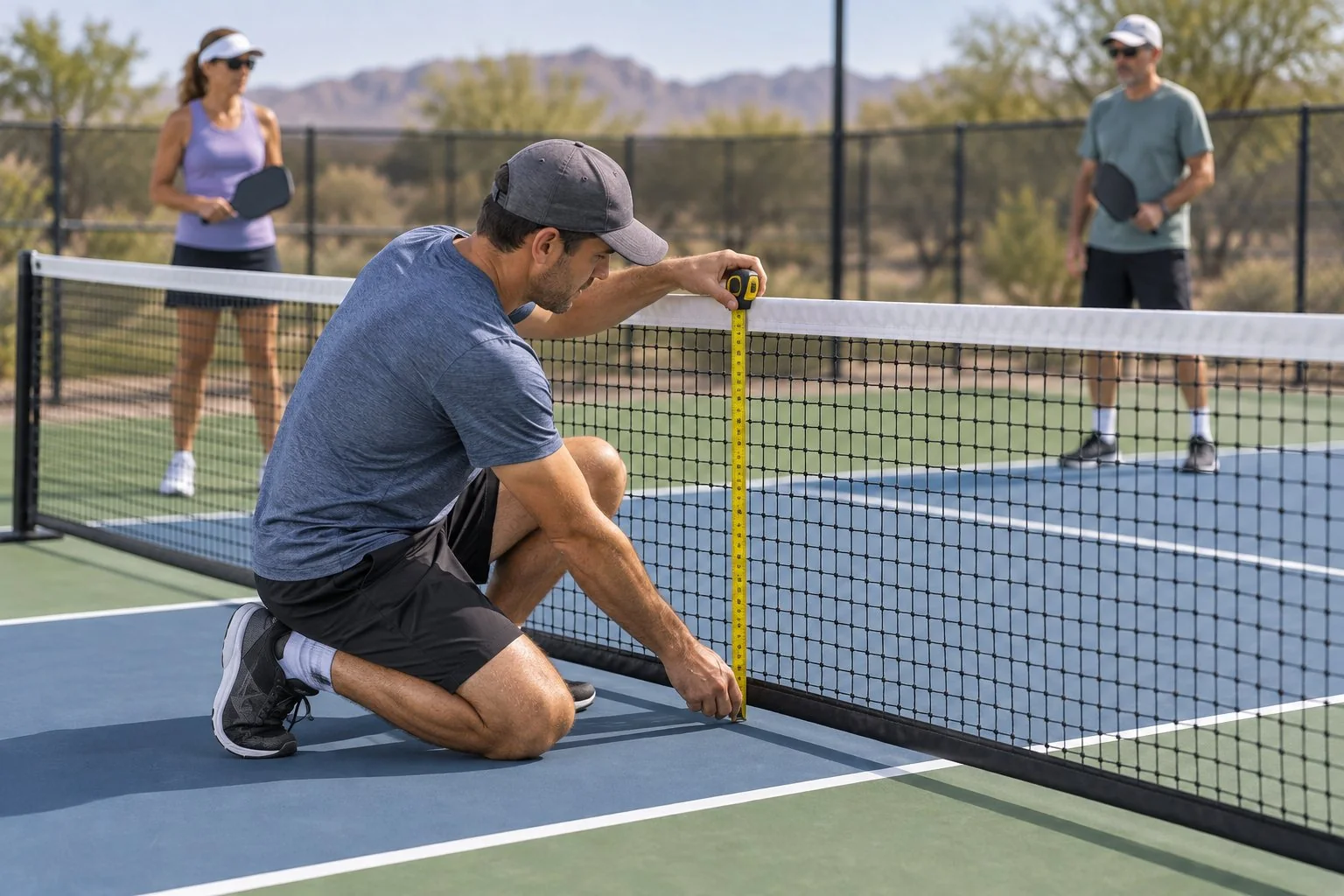
Start by confirming that the net is designed for pickleball rather than tennis or another court sport. A pickleball net spans the full court width, and its center should be slightly lower than its ends. For a regulation-style setup, the top of the net is 36 inches at the sidelines and 34 inches at the center. Those measurements matter because the center of the net is where many players send dinks, drives, and passing attempts.
Use a measuring tool instead of judging by eye. Place it beside the net at one sideline, then repeat the check at the center and the opposite sideline. The top edge should be measured consistently; do not measure from the ground to a loose strap or a section that has folded over.
Next, inspect the court itself. The net should cross the center of the court, with the posts outside the playing area and the net aligned with the centerline. Check that the posts are not sitting on a painted line where they could move during play. On a temporary court, compare the net position with the marked sidelines and non-volley-zone lines before anyone serves.
How to tension a portable pickleball net
Assemble the frame on a flat surface and connect every section before tightening the center strap. Pull the net fabric evenly from both sides. The goal is a firm, level top edge—not the tightest possible cable. Excess tension can bend a lightweight frame, while too little tension leaves a deep sag that changes the visual target for players.
Most portable systems use a center strap or adjustment buckle. Tighten it gradually, then step back and look along the top edge. If one corner is higher, loosen the strap slightly and square the frame before making another adjustment. A helper can stand at the opposite end and confirm that the posts are parallel to the sidelines.
After the net reaches the right height, test its stability with a gentle hand touch. It should not rock significantly, and the base should stay flat. Do not lean your body on the net or use it as a barrier. Players may brush past it while chasing a ball, so remove loose bags, cords, and ballast from the space around each post.
Portable court safety checks
Before the first rally, look for trip points around the bases, connecting joints, and center strap. Keep spare balls outside the active court. If the net is being used on asphalt or another hard surface, make sure the feet have not slid from their original positions. Wind can move an unweighted system, especially when the net has a wide fabric panel.
A quick pre-game routine is enough:
- Confirm the net is centered between the sidelines.
- Measure the top edge at both ends and in the center.
- Check that the frame is square and the feet are flat.
- Tighten the strap without distorting the posts.
- Clear bags, cords, and loose balls from the playing area.
- Recheck the net after the first game or whenever it is bumped.
If the net shifts during play, stop at a natural break rather than trying to fix it while a rally is active. Tell both sides what changed, adjust the frame, and restart with a clear score. In a recreational session, agreeing on a consistent correction is more useful than debating a single point.
How to store and maintain the net
Dry the net and frame before packing them away. Fold the fabric without forcing sharp creases, and keep metal connectors together so a missing joint is noticed before the next session. Avoid leaving a portable net in direct sun or rain for long periods; weather exposure can weaken fabric, straps, and plastic fittings.
Inspect the system each time you set it up. Look for frayed stitching, bent posts, cracked feet, and buckles that no longer hold tension. Replace a damaged component before a busy community session. A reliable pickleball net setup is ultimately a repeatable habit: measure it, square it, secure it, and check it again after play begins.