Pickleball Transition Footwork: Stop, Split, or Keep Moving
A practical transition-zone guide to split-step timing, three movement decisions, common errors, and drills that help you reach the kitchen without giving away the point.
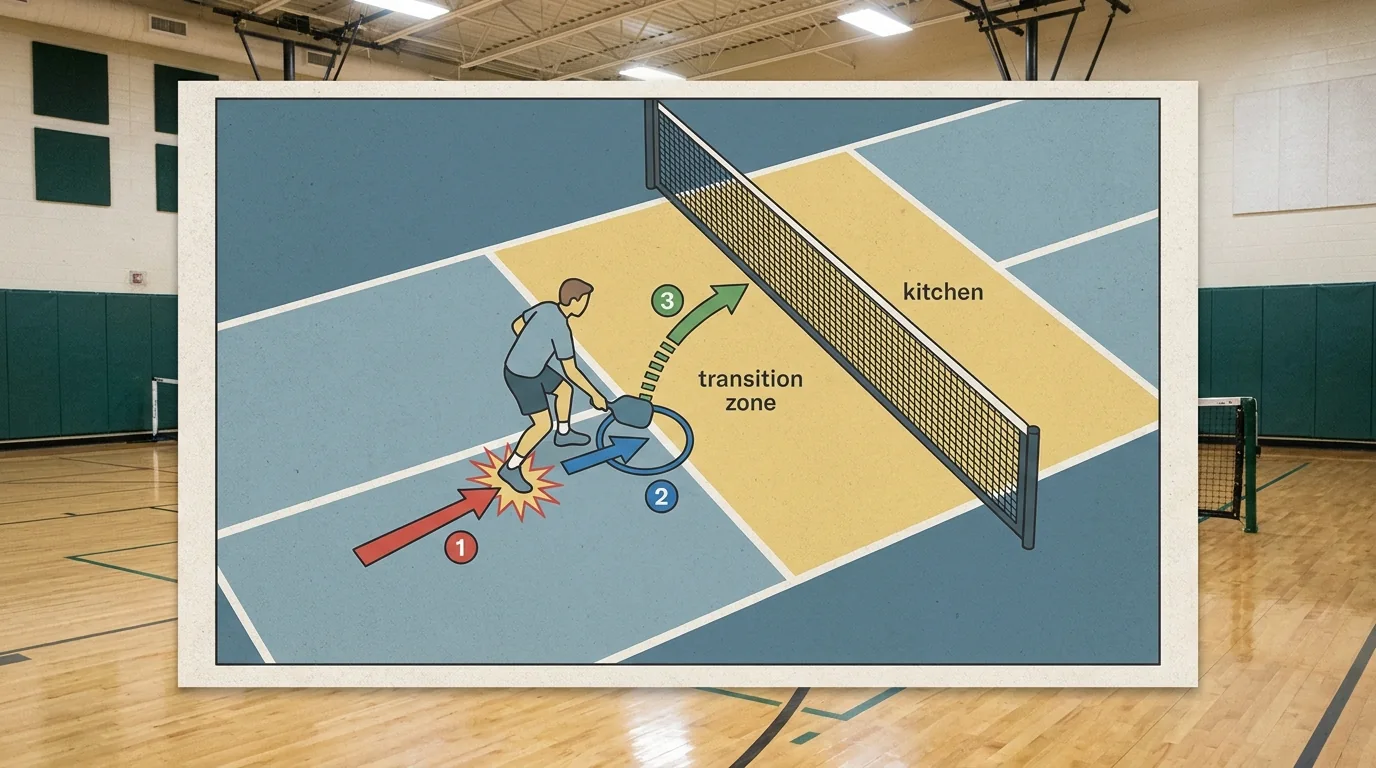
The transition zone is the roughly fourteen feet between the baseline and the non-volley line. It is also where rushing can undo an otherwise good rally. You are close enough for a kitchen player to drive at your feet, but you are not yet in a comfortable net position. Instead of sprinting at every ball, make a footwork choice, build a base, and move again only when the next shot gives you a reason.
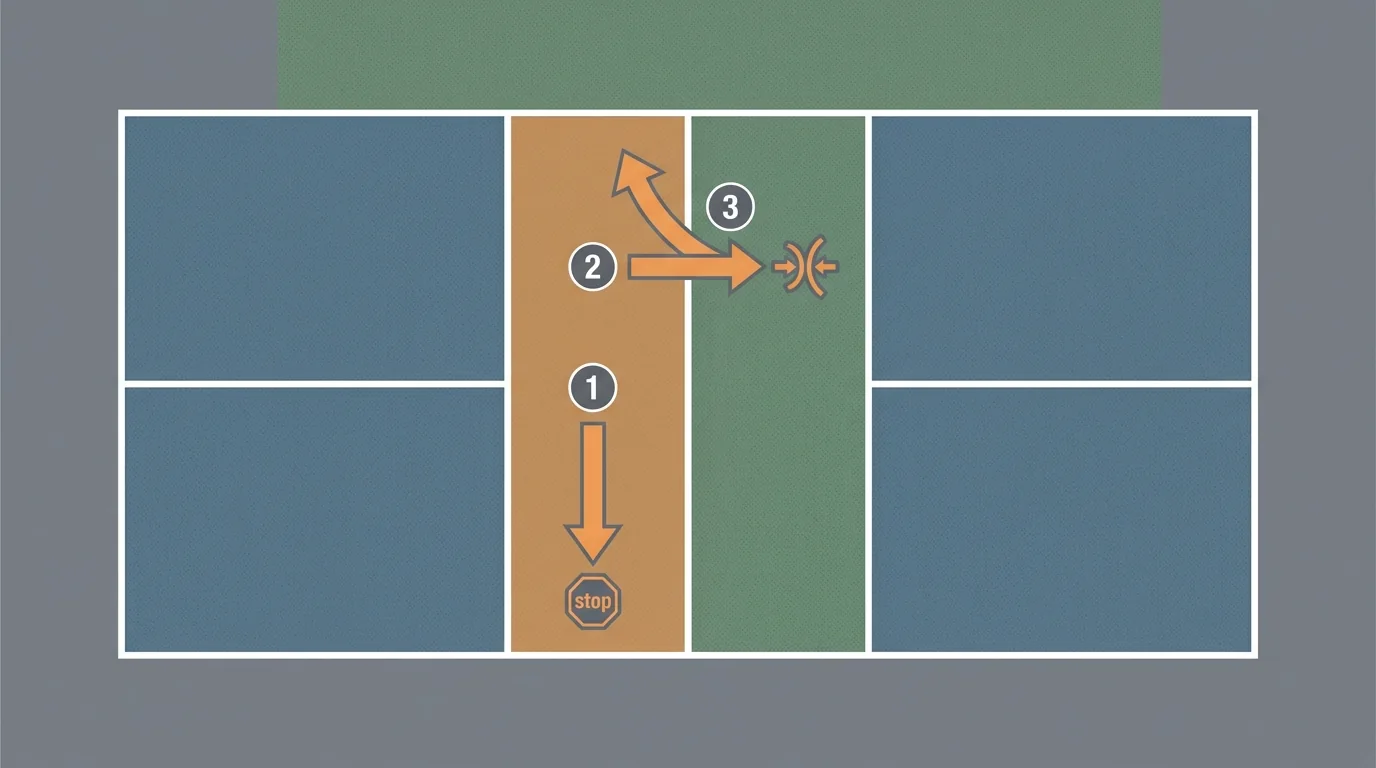
There are three useful choices: stop and reset, keep moving with control, or plant and absorb a hard drive. The split step connects all three.
Read the zone in two halves
The back half is farther from the kitchen. You still have time for a small adjustment step, a balanced setup, and a controlled drop or reset. In the front half, the ball arrives sooner. Treat most low contacts there as resets unless the ball rises clearly into a comfortable strike zone.
Before moving, check three things: the quality of your last shot, the height and pace of the incoming ball, and your own balance. A strong drop or a deep ball that pushes the opponent back may earn forward movement. A weak ball or a drive at your feet may call for patience. Your partner’s position matters too. A large gap between one player at the kitchen and one player in mid-court gives the opponents an easy lane.
Time the split step to contact
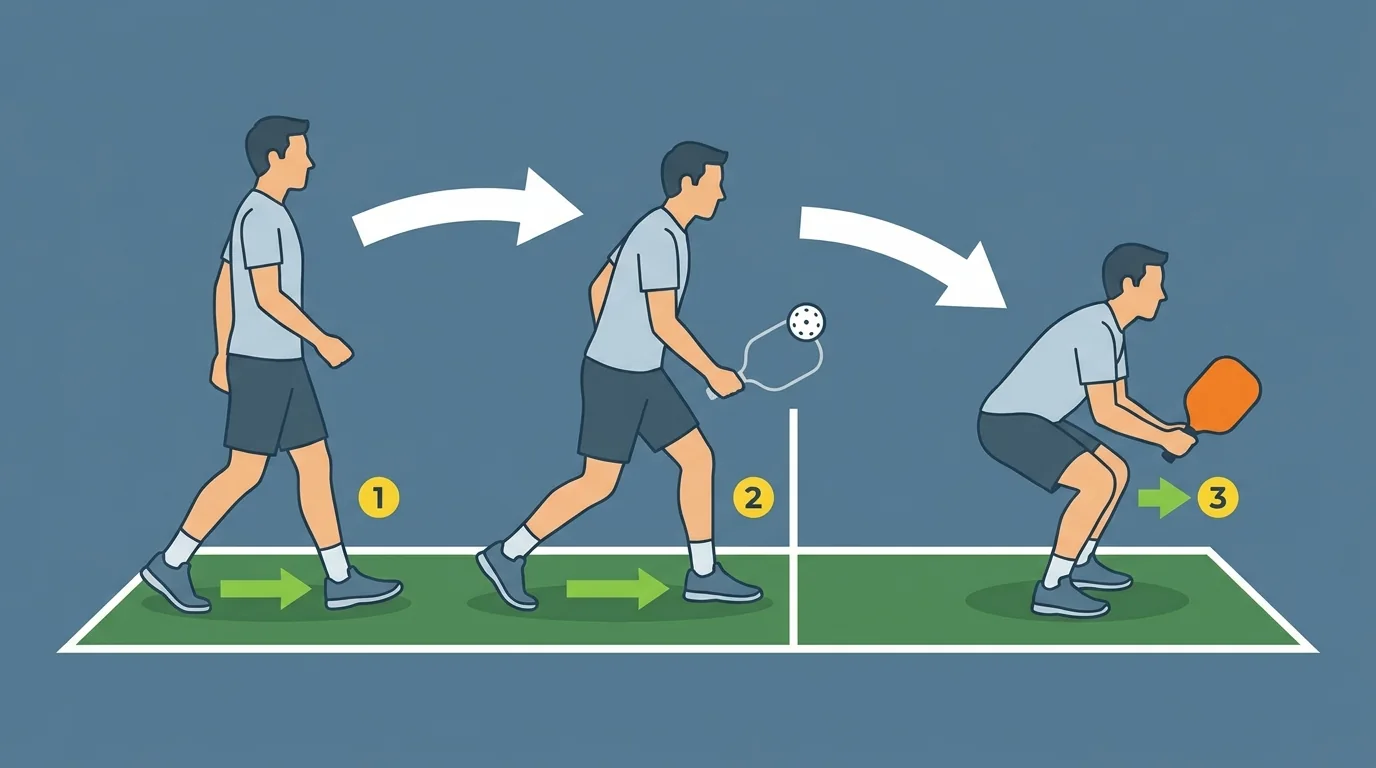
A split step is a small hop that lands with your feet about shoulder-width apart, knees soft, weight balanced over the balls of your feet, and paddle out in front. Use the opponent’s contact as the cue, not the start of the swing and not the bounce. Land as the opponent strikes so you can react in either direction. Land too early and you are planted before the ball’s direction is clear. Land too late and you are still airborne when you need to hit.
Think of the rhythm as step, split, hit. Do not keep stepping while the ball is being struck. Forward momentum shifts your contact point, often lifts a low ball, and turns a controlled reset into a floating pop-up. Move between contacts, then stop long enough to hit from a stable base.
Choose whether to stop, advance, or absorb
Stop and reset when your last shot was low but did not clearly force the opponent back, the incoming ball is at or below your knees, and you are still in the back half. Plant, split, keep the paddle forward, and guide a soft ball into the kitchen. Do not advance while lifting a low ball. Neutralize the pressure first, then earn the next step with the quality of the reset.
Keep moving when your last shot pushed the opponent back, the incoming ball is high or floating, you are already in the front half, or your partner has reached the kitchen and you are closing the team’s gap. Split on contact, then take one controlled step toward the line. Do not sprint. If you arrive in a rush, your weight will still be moving when the next ball comes back.
Plant and absorb when a hard drive reaches your feet while you are caught mid-transition. Put both feet down, stay slightly forward and low, and use a quiet paddle to cushion the pace into a soft kitchen reset. Do not try to run through the shot, and do not retreat blindly. This is the survival choice that keeps the rally playable.
Fix the errors that expose your feet
Walking forward through contact is the common mistake. It feels aggressive, but it takes away the stable base needed for a low reset. Reaching with the paddle instead of moving your feet tilts your body and leaves little room to recover. Standing tall gives you less time against balls near the knees. Closing too quickly after an average drop is risky too: match your speed to the shot you actually hit, not the shot you hoped to hit.
In doubles, do not try to repair a partner’s position by sprinting alone. If your partner is back, stay connected. If your partner is up, close the gap in measured stages. Use a short call before the point and a clear cue during movement so both players know whether the next ball calls for a reset or an advance.
Three drills for transition control
Start with a shadow drill. From the baseline, mime a third-shot drop, take two controlled steps, split, mime a reset, take one step, split again, and then plant at the kitchen line as if you were volleying. Return to the baseline and repeat ten times. The goal is to make the rhythm familiar, not to move as fast as possible.
Next, use a two-on-one reset drill. Two players at the kitchen alternate drives at the feet and soft drops to one player moving through transition. The lone player resets every ball and tries to complete twenty controlled contacts without a pop-up. Rotate after each successful set. This puts a planted base under realistic pressure.
Finally, use a line-to-line ladder. Begin at the baseline, take two steps after the first feed, split and hit a controlled drop, then take two more steps for the next feed. Finish with a volley at the kitchen, retreat, and repeat. Once the basic pattern is stable, add a recovery call from the kitchen-line position. Count clean ladders, not just points won.
The transition zone is not where you prove that you can run fastest. It is where you preserve options. Split on contact, stop for low balls, advance behind good shots, and absorb pressure when a drive reaches your feet. When your feet set the timing, the kitchen becomes a position you reach with balance instead of a line you chase.