Pickleball Doubles Rules: Serve, Score, and Position
A clear guide to pickleball doubles serving, scoring, the two-bounce rule, kitchen faults, and partner positioning.
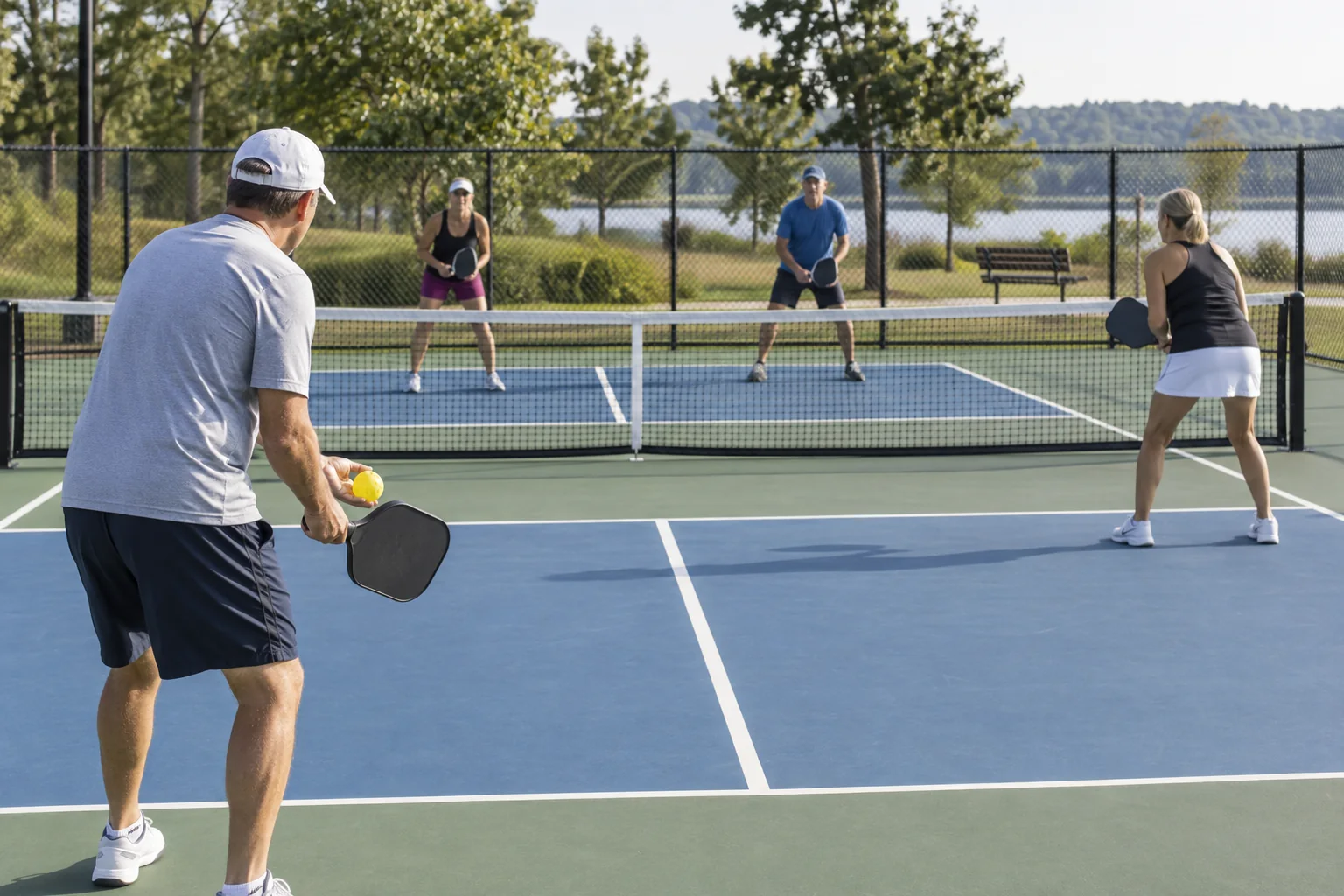
pickleball doubles rules are easier to follow once you separate serving, scoring, court zones, and partner roles. In a standard doubles game, two teams of two play on a 20-by-44-foot court. The team serving must manage the rotation, let the opening return sequence unfold, and then work toward the kitchen without committing a fault.
What are the basic pickleball doubles rules?
Each rally begins with a diagonal serve. The server stands behind the baseline and sends the ball beyond the opponent’s non-volley zone, commonly called the kitchen. The kitchen extends 7 feet from the net on each side, and its line belongs to the zone for volley restrictions.
Doubles has two players on each team, but the court does not become wider. Partners therefore need a shared plan for the middle, the kitchen line, and the space behind a player who moves wide. The receiving team usually has one player ready near the kitchen while the returner starts deeper, which gives the receivers an early position advantage.
A useful way to remember the court is simple: the baseline controls the serve, the diagonal box controls the target, and the kitchen controls where a volley is legal. For a broader tactical example, see pickleball doubles strategy.
How does serving work in pickleball doubles?
At the start of a game, the opening serving team gets one server before a side-out. Players announce the starting score as “0-0-2,” where the final number identifies the second server rule. After that first side-out, both partners normally serve in sequence before the opposing team receives service.
When a serving team wins its rally, the current server changes sides and serves again. When that server loses the rally, the partner takes the next service turn. If the second server also loses, service passes to the other team. Partners do not automatically swap sides merely because their team has earned the serve; each player serves from the position required by the rotation.
The serve must travel diagonally into the opposite service court. The server must keep at least one foot behind the baseline, and no foot may touch the baseline or court before contact. A legal drop serve is also possible: release the ball without throwing it downward, allow it to bounce, and then strike it.
How do you keep score in doubles?
Traditional doubles scoring uses three numbers. The first is the serving team’s score, the second is the receiving team’s score, and the third identifies the active server. Thus, “4-2-1” means the serving team has 4 points, the receiving team has 2, and Server 1 is serving.
Only the serving team scores in side-out scoring. A receiving team that wins the rally gains the serve but does not add a point. Games commonly go to 11, with a two-point margin required. At 10-10, play continues until one side leads by two.
For example, imagine Team A leads 6-4 and Server 2 is active. The call is “6-4-2.” If Team A loses the rally, Team B gets the serve and the score remains 6-4. If Team A wins instead, it moves to 7-4 and the same server changes sides for the next serve.
What is the two-bounce rule in doubles?
The two-bounce rule requires the served ball to bounce once on the receiving side and the return to bounce once on the serving side before either team may volley. This prevents the serving team from rushing directly to the net after serving and creates the first tactical transition of every point.
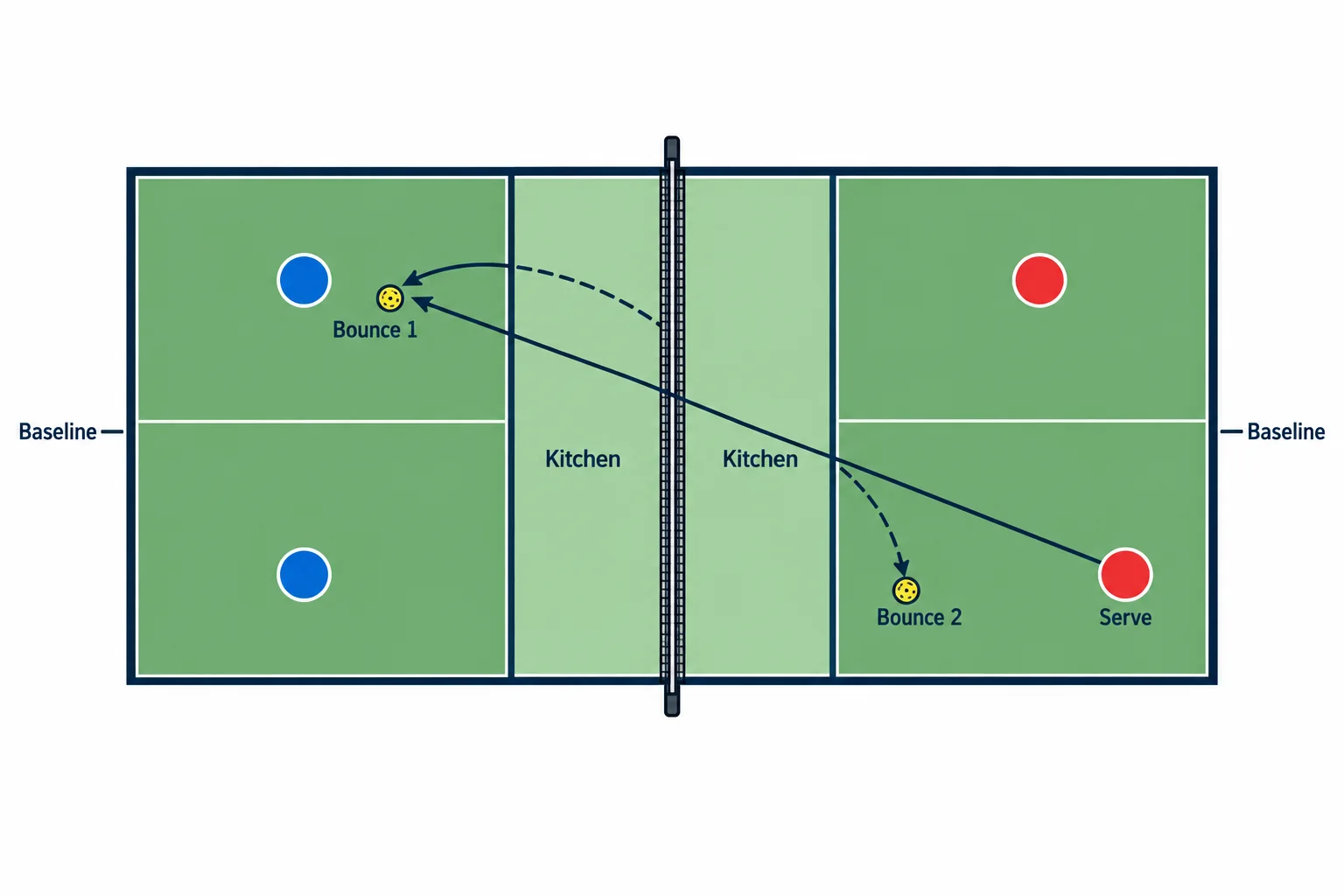
A simple sequence is: serve, receiving-side bounce, return, serving-side bounce, then volleys become available. If the receiver volleys the serve before it bounces, that is a fault. If the serving team volleys the return before its own side has allowed the bounce, that is also a fault. After both bounces occur, normal volley rules apply.
The rule shapes shot selection. A deep return can hold the serving team back, while a controlled third shot can help that team move forward. See third-shot strategy for the decision between a drop, drive, and lob.
Can you step into the kitchen in doubles?
Yes. Entering the kitchen is legal when the ball has bounced before you hit it. The restriction concerns volleys. A player may not volley while standing in the kitchen, touching its line, or touching an object connected to the zone.
Momentum matters too. Suppose a player volleys from outside the kitchen, then steps onto the kitchen line while completing the movement. That is a kitchen fault, even if the ball has already crossed the net, because the player has not regained balance before touching the zone.

A practical habit helps: stop behind the line, keep the paddle in front, and let a ball bounce before entering. Players can stand inside the kitchen between rallies or to play a bounced ball, so there is no need to retreat automatically after every exchange.
Which faults occur most often in doubles?
Common faults include:
- serving into the kitchen or outside the diagonal service court;
- stepping on the baseline before serving;
- volleying before the two required bounces;
- volleying while touching the kitchen or its line;
- allowing a volley’s momentum to carry the player into the kitchen;
- hitting the ball out of bounds or into the net;
- letting the ball bounce twice before returning it;
- calling the score or server number incorrectly.
Line rules can cause confusion. The kitchen line is a fault when a serve lands on it, but during ordinary rallies it is part of the kitchen boundary and a volleyer may not touch it. Other boundary lines generally count as in when the ball lands on them.
How should partners position themselves?
The strongest general formation is often both partners near the kitchen line, side by side, with enough space to cover their lanes and the middle. During the transition from the baseline, move together. If one player advances while the partner stays deep, a large gap opens between them and opponents can target the feet.
Agree on the middle before serving. A common arrangement gives a neutral middle ball to the player whose forehand faces the centre, but the pair can choose another rule. Use short calls such as “mine,” “yours,” and “switch.” Clear words beat late gestures.
For a beginner, one repeatable routine is enough: return deep, move in small steps, split-step before the opponent hits, and reset a low ball rather than attacking while moving backward. Practise ten returns, then ten third shots, and count only balls that land in the intended area. If 7 of 10 third shots land low in the kitchen, the result is 70 percent, which shows useful control but still leaves room to practise under movement.
Pickleball doubles rules FAQ
Who serves first after a side-out?The player standing on the right or even side serves first when the team gains service, while the regular two-server rotation applies after the opening exception.
Can both partners stand in the kitchen?Yes, provided they do not volley while touching the kitchen or its line. They may hit a ball after it bounces inside the zone.
Does the receiving team score after winning a rally?Not under traditional side-out scoring. The receiving team earns the serve. The score changes only when the serving team wins a rally.
What should new doubles players learn first?Learn the score call, the two-bounce sequence, kitchen faults, diagonal serving, and coordinated movement. Those basics prevent more points from being lost than risky advanced formations.